Saturday, April 16, 2011

Spice Tour

So after our amazing day of snorkeling and lounging yesterday, we wanted to see a little of what made Zanzibar globally famous. No not Jack Black, but rather spices. Zanzibar was at one time the largest exporter or spices in the world, and though places like India and Indonesia have taken a large share of the spice industry from Zanzibar, a large industry remains.

We were picked up from our hotel at around 9 am and then drove 30 or so minutes to the spice plantation where the tour was done. We were led by a university student who was studying for an exam in communication off of his cheat sheet while we walked between the different spice sections. Multitasking like an American.

We started with turmeric, which is a root related to ginger. He passed around cut sections of the root, and encouraged us to smell them. He also warned us that if we tasted it, it would stain our teeth, but for some reason, I didn’t believe him. 8 hours later, I’m writing this blog with yellow teeth.

We then walked through the following spice/fruit areas: cinnamon (the leaves smelled like cinnamon, but the roots like eucalyptus!), ginger, nutmeg, mace (nutmeg and mace are actually the same plant!), cloves (Zanzibar is famous for cloves), curry, starfruit, bananas, vanilla (grows on a vine and has to be hand-pollinated because the bees that pollinate them are only found in Mexico) , birdseye peppers (JBP couldn’t even tolerate the sight of them), among others.

The red is the mace and the dark colored nut in the center is what you grind to get nutmeg:


There were a few coconut trees, and one of the local boys gave us a demonstration of climbing the trunk to harvest some coconuts for us. He sang the whole way up, as apparently the rule is that if you’re singing, you can’t be held responsible if a coconut falls on the head of a passerby. Actually, this makes good sense. Of course, I asked to try to climb as well, as it looked so easy. Apparently, a lifetime of practice makes it look easier than it is. I made it up a few feet, at which point I had succeeded in making my clothes filthy and skinning up my arms.

Notice John's shoulder for reference on how high I climbed:


Fortunately, our next stop was the iodine tree, which bleeds the famous antibacterial fluid. After rubbing that salve on my wounds, we progressed though the red mahogany and teak sections, passed through the spice market, and then sat on some mats for a “spice lunch”, which consisted of pilau (spiced rice), coconut curry, and spinach. The food was pretty good, though the pilau had whole cloves and big pieces of cinnamon bark, which proved slightly fibrous. We then headed back to the van in a deluge, which was actually quite refreshing.

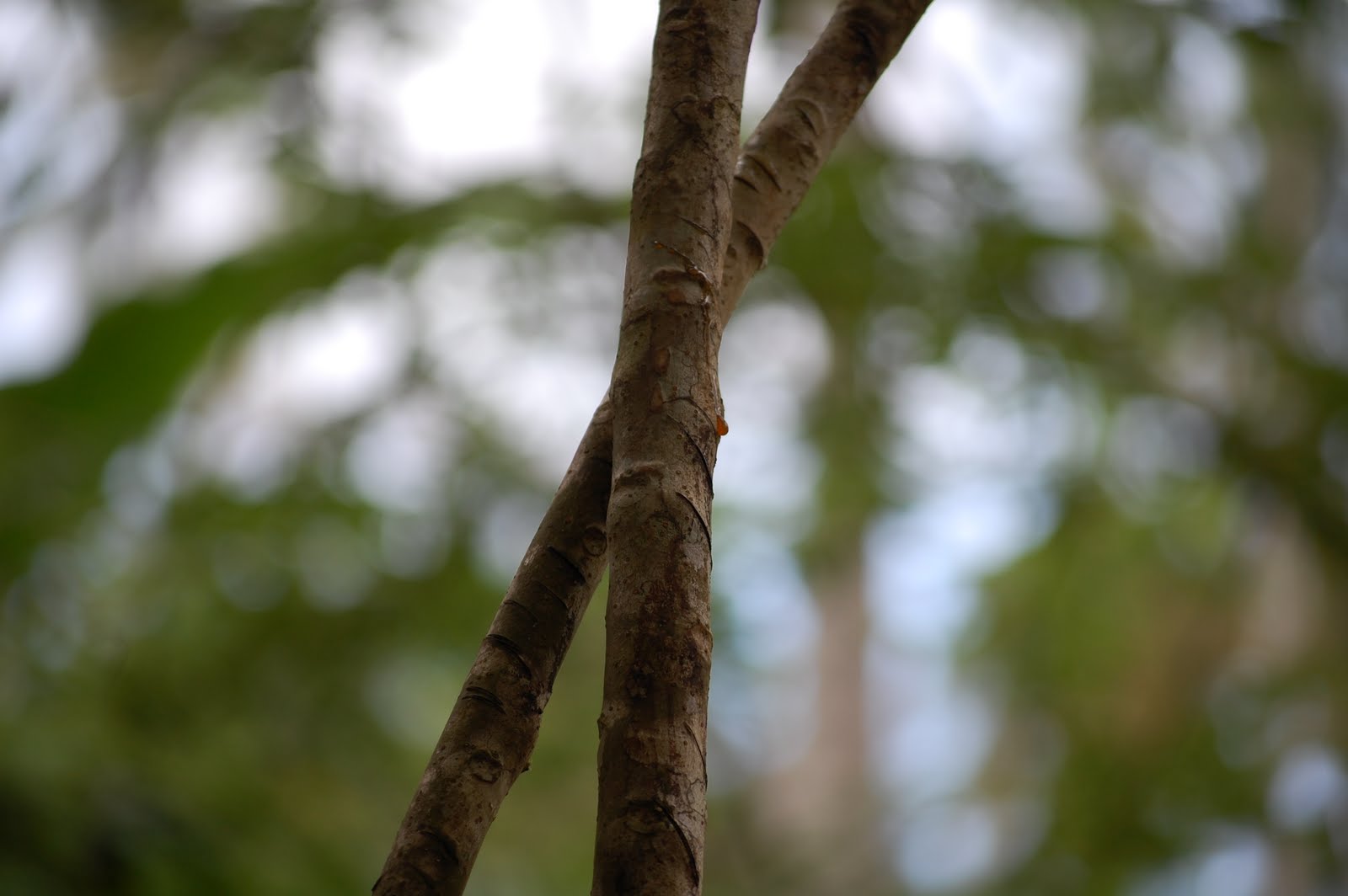
That drop you can see on the right of the bark is iodine (click to make it larger). When you cut the tree, it bleeds iodine:


The deluge starting:


We haven't seen daytime rain since September so this was very exciting. The other tourists thought we were a bit strange:


The tour was actually really fun. It was cool to see what the spice plants look like, as aside from things like thyme and basil, we in the Western world don’t ever see spice plants. Here, spices are grown everywhere and are quite a bit cheaper than in the US. Our hotel serves homemade jams at breakfast with a ridiculous amount of vanilla bean in the jam, which is just delicious and not economically feasible in the US.

After the tour, we took the requisite McRun though Stone Town, which is the part of town with very narrow alleys and people who are very interested in giant and tiny Americans running around in the middle of the afternoon.

We have our last night in Zanzibar tonight, and then we head Arusha, in central Tanzania. Stay tuned!

Friday, April 15, 2011

Chumbe Island

Our first full day on Zanzibar was spent on Chumbe Island (confusing that we spent our first day elsewhere but it’s true!). This island is in the Zanzibar archipelago but is one of the smaller islands and was not permanently inhabited until the early 1900s when a lighthouse was built there.

This island now has an eco-resort and allows day-trippers to come over and use their facilities on a limited basis. We left Zanzibar by a 15-ft boat for a 45 minute motor over to the island and it looked gorgeous:


Our first stop was our private “banda” for the day. The bandas (and everything else on the island) were built to exacting eco-lodge standards. The lodges are open-air and constructed entirely of bamboo, coconut trees, and palm trees. The palm tree roof collects water in fill a giant cistern under each banda since there is no fresh-water source on the island. The water runs off the roof and through a series of sand filters before entering the cistern. M, obviously, was fascinated especially when it began to rain and he could see the whole thing close-up. Dirty water from showering is collected, cleaned, and reused in the kitchen garden and all toilets are composting, etc. It was a really neat operation and a far cry from most of East Africa which is littered with plastic water bottles. Since water processing is so time consuming, anyone who can afford it will simply buy water in plastic jugs or bottles. There aren’t trashcans anywhere in public so people just throw them on the ground.

The banda:


Water filtration:


The main reason for our trip was the reef off the island so we headed down to do a little snorkeling. One really unique thing about this reef is that scuba divers are not allowed. Scuba diving is a bit of a double-edged sword in terms of conservation. Done well, it allows people to appreciate and see the biodiversity which makes them more likely to protect it. It is usually not done well. Many companies are eager to get the high-paying folks onto the reef as fast as possible. Using unfamiliar (and sometimes very old) equipment, divers will often empty their air bladders and go crashing into the reef, swim too close to coral, or try to touch or chase corals or other animals because they forget it’s not allowed. This reefs protected status made it some of the best snorkeling I have ever seen:


Less than 20 ft below us were huge corals in colors I have never seen like blue or green. There were tons of fish including some 150-lb grouper (delicious according to M), lobster, and giant clams. JPB’s new camera allows underwater photos so we took a lot.

After about an hour of snorkeling, we retired to the beach for a delicious lunch and then naps in our banda. Since it’s rainy season, we got a storm from 2-4 which was delightful for sleeping since it broke the heat.

We returned back to Stone Town in Zanzibar (the main town on the island) around 5 PM. We showered up quickly before heading back out to happy hour. The Tanzanians are generally acknowledged to be more polite than the Kenyans, even by the Kenyans themselves, so there is significantly less harassment here than in Mombasa. The boys quickly found their favorite spot, Forodhani Park, where they were 30 tables set up selling fresh seafood skewers ready to be grilled to order. M has never met a fish or streetfood that he didn’t like and apparently JPB feels the same way. So, streetfood dinner it was! Tuna, barricuda, crab, prawn, and octopus skewers were all quickly procured and enjoyed:


After filling our stomachs, we headed to a local bar where the chief amusement is watching the car ferry to the mainland load each night. There is no ramp so the ferry comes straight to the beach and then cars race down the beach so they don’t get stuck in the sand narrowly avoiding crashing into other cars and bystanders. This was a source of endless amusement and proves once again that Kenyans (and apparently Tanzanians) can put up with a lot of angst.

Tuesday, April 12, 2011

The Equatorial Haircut Part Deux & Safari Itinerary

So today we took JPB to Mombasa for a little culture. We basically repeated the general tour of Mombasa that covers the Portuguese fort (Fort Jesus) and Old Town.

The most amusing part of the day was to actually get to Mombasa which was quite amusing as the boys tried to squish into matatus and tuktuks to get around:


After several hours of sweating in the sun, JPB turned to me and said, “I think I’m ready for that haircut”. Before JPB arrived, I had jokingly mentioned in an email the rule about shaving your head when you crossed the equator. Turns out, he was due for a haircut and game to visit a kinyozi (Swahili for barber).

Here’s the before:


The during:


And the after:


So, now, we are ready for safari! We leave today on a 9-day trip that will take us south to Zanzibar, west to the Serengeti and finally north to Nairobi. We are dropping JPB off before returning to Diani for Easter.

Some maps of our route:

As you can see, we'll basically only be in the northern-most part of Tanzania, very close to Kilimanjaro and the Kenyan border:

View Safari in a larger map

Here's our route:

View Safari in a larger map


View Safari in a larger map

We are very excited to go on this trip after so many hours in the lab over the last few weeks. We should be able to blog along the way so we’ll keep you updated.

JPB is here!


Yesterday morning, M went to the airport bright and early to pick up JPB for his visit to Kenya. Needless to say, we were very excited to see him!

You can see that he brought tons of technical gear on our recommendation since we won't have much laundry for the next two weeks. The boys look like a walking North Face ad with all their wicking clothes but I think they're quite pleased with themselves.

M took him on a tour of the hospital, the lab, and the town of Msambweni. He even practiced a little bit with the pippette:


They took a romantic walk in the tidal pools in Msambweni:


And the day was finished with beers on the beach:


Anyway, today the boys are off for a tour of Mombasa before we leave tomorrow for Zanzibar. I will update more about our itinerary for the next 2 weeks tomorrow.

Friday, April 8, 2011

Road Warriors

Next week, M's friend from college JPB is coming to visit! We are thrilled to host him on a tour of East Africa. We'll update more on the itinerary later but we thought we'd show you what he's in for on our bus rides.

Here is a video taken from our bus ride home from Kilimanjaro. This is in southern Kenya near a town called Voi.

A few things to really appreciate:

1. Kenyans drive on the left side of the road. Notice, however, the
driver 'skillfully' using the entire road to find the route that he
likes best. In fact, he even uses both shoulders when he finds them
to be less potholed than the actual roads.
2. Notice the oncoming car doing the same and almost hitting us.
3. That hissing sound that keeps going on and off is the brakes
4. We almost hit a donkey.

Wednesday, April 6, 2011

Goat Addendum

We are just constantly amused by the goats that surround us here, so here’s an update of all things goat:

1) Goats make great presents. We bought our friends three goats as their wedding gift.

If you recall, we were in charge of the gift table at the wedding and there was some question as to our qualifications in the case of live presents. Luckily, no one gifted a live goat so goat wrangling was not part of our wedding-day duties.

2) Downward-facing goat is going to be the hot new yoga pose


3) Goats like to gather under the shade of the old gum tree during the heat of the day with their babies, it's really cute:


4) However you shouldn't be fooled by the cuteness because the goat antichrist lives in Msambweni.

This requires some explanation. A few months ago, while walking between buildings at the hospital, I passed by a certain black goat, that made the most horrific sound. I did the impression several times for E, and I thought that she was going to hit me because it was such an annoying sound. I don’t think that she believed that it was real, but just a few days ago, she finally heard it for herself, and she is now a believer. I was fortunate enough to capture it on film for the very first time to share it with the world. This goat may go viral.


Also, E pointed out that this beast is actually a sheep, not a goat. However, we’ve decided that it’s likely a goat in sheep’s clothing, being the antichrist and all.

5) Pregnant goats appear to have swallowed several watermelon (check out the goat on the left)


6) If your dog bites a neighbors goat, it may evolve into a months-long drama

A few months ago, our friends’ dog attacked a neighbor’s two goats. One escaped with just a few punctures, but the other was bitten in the neck and was having difficulty eating and drinking. The neighbor then demanded that Chris pay him 40,000 KSH (about $500) for damages. This makes very little sense, as a good goat costs no more than 4,000 KSH, thus 8,000 should have been the maximum penalty.

Incidentally, Kenyans know the price of a good goat at all times. Goat prices are the Kenyan equivalent of the Nasdaq. This logic involving the real price of goats did not persuade the man, so Chris had to go to the village elders to discuss the matter. The elders agreed that the man was being ridiculous, and that he only had to pay for the value of the goats, assuming they died. After some penicillin and TLC, both goats survived and have since had baby goats. However, one of the goats had twin goat babies and one of the babies died, which resurrected the goat saga after a two month hiatus. The owner claims that it is due to the “dog poison”, and that Chris should pay him 10,000 KSH (about $125). Chris asserted that his dog is non-poisonous, and again, the price of an adult goat is no more than 4,000.

The guy would not back down so in the spirit of neighborly behavior, Chris offered to pay the man 8,000 and to keep the goats since he would have effectively bought them. The man countered with Chris paying 10,000 and that he keep the goats. Chris realized this was going nowhere so he offered the man 1,000 KSH as an apology with no goat exchange required. The man was so offended by this gesture that he stormed off deciding that making a good scene was better than taking “only” 1,000 shillings.

Anyway, they are an endless source of amusement and traffic jams so we wanted to share them with you all.

Sunday, April 3, 2011

The UTI Project


So we’ve mentioned a few times that because of the sample debacle with his original project, M decided to pursue another research project while we’re here, especially since it’s urology related. M has settled on urology when he applies for residency next year so this was a good opportunity to perform some urology research.

The vaccine project M is working on collects tons of data on maternal and baby health and one of the routine things they do at the first prenatal visit is a screening for urinary tract infection. Urinary tract infections can have significant impact on fetal outcomes including preterm birth and low birth weight so it was interesting to the researchers that Msambweni mothers had positive results for urinary tract infections (UTI) about 50% of the time. The researchers didn’t have time to pursue this angle since they were focusing on other diseases but they told M about it and he decided to look into it.

First, he wanted to determine if there was a difference between the tests they were using (a simple dipstick) and the gold standard test, a urine culture. Second, what kinds of ‘bugs’ were causing these infections? The goal of course is to figure out if these women do indeed have lots of UTIs and if so, how to treat them. The current dipstick test gives no information about what kind of organism caused the infection so the doctors are blindly prescribing medication that may not help the women.

He designed a simple study for 150 women. The women would give a urine sample and then the sample would be tested with a dipstick and a culture. This demonstrates the accuracy of the dipstick. If the culture was positive, the infection would be identified (i.e. is it a Staph infection, an E. coli infection, etc.), and then it’s sensitivity to various antibiotics would be identified so that women could receive the correct antibiotic. Sounds fairly simple, right? Wrong. Have you learned nothing about Kenya?

First, he approached the nurses about the project. Even though the study is already paying them, they all wanted more money to be a part of M’s extension study. Their part includes a 30 second description of the study, writing the patient’s name and age and sending them to the lab. They were having none of it. After several meetings, they absolutely refused unless they could have more money. M explained how this could help their patients and how it was a part of the original study, even going so far as to show them the protocol but it was not happening. Msambweni has the worst infant mortality rate in the country but here it’s all about the money, only slightly maddening.

Then M approached the people in the lab where he works. Would they be willing to do the dipsticks since they had originally done the dipstick work? Turns out, the nurses had riled up the lab staff and they were having none of it. They wanted more money and they were concerned that their work was being “quality-controlled” against the cultures. Apparently in Kenya, the idea that your work might be checked for accuracy is horrifying. That wasn’t the aim of the study and M (and his advisor) explained it several times but they would not help. Mzungu, who I was working for, outright refused to help and led the others to refuse as well. Needless to say, I stopped working for him a few days later.

The only people who were happy to help were the people in the hospital clinical lab. You see, these guys were not involved in the other study so by helping, they were getting paid. Apparently the people who were already getting paid (the nurses and the people in M’s lab) had heard about this and that’s why they were demanding more money.

Eventually, one person from M’s lab came forward and said he needed to write a paper for his Master’s thesis and he would help if he could use this research too. He would like M to explain to him the project and for M to turn over all the papers he had found to back up the need for this study and then he would help. Perfect. With time dwindling, M agreed to help the guy out in exchange for his assistance since the master’s thesis would not be publishable in medical literature and it seemed the only way to get this done.

Meanwhile, while all this wrangling over who would help was occurring, M and I were helping the lab get their procedures for the cultures up and running. This sounds more formal and glamorous than it really was. Basically it just involved us giving repeated urine samples every day and they would culture it. Sometimes we contaminated them to make sure that these were showing up properly on culture. I’m sure everyone at the hospital thought we were insane since we spent a solid week carrying our urine around every time we left the bathroom. After a while, we started joking that we should just write a paper on our urine since no one would agree to help. We envisioned the methods section of the paper reading, “So, my wife and I peed in cups and cultured it…”. Lovely.

Actually though, our testing paid off because we realized very quickly that the samples were being contaminated by airborne contaminants floating around the hospital clinical lab. The lab is not air conditioned; in fact it’s about 100 degrees at all times. Without proper ventilation and air filtration, mold spores were drifting onto and contaminating the plates. We did a test where we opened a plate, waited one minute and closed the plate. The next day the plate was covered in mold. Also, we did a plate where we never even opened it, and mold even grew on that one! Turns out they poured the agar (the stuff on which the bacteria grows) to make the plate in open air and thereby contaminated it. M finally agreed with them that all samples from this project would be done under the lab hood and though there’s still contamination, it had been significantly reduced.

Here’s the lab below:


Did you notice the open windows and the mold on everything? Also, notice how much the refrigerator is sweating:


Also, their only equipment is microscopes and centrifuges. They have none of the standard equipment seen in an American hospital lab. Heck, they don’t even have ventilation!

Here is their equipment:


Eventually though, we finally got everyone together and on the same page and were ready to start the study. At this point, 40 mothers have been recruited and the findings are very interesting. The rate of UTI is higher than would be expected and the bacterial causes appear to be different than in US. It’s still very early the study, but contributing factors may be dehydration, hygiene, or sexual practices.

M bought some cool agar that actually determines what the bacteria is by turning a specific color so here are the results:


The blue is Enterococcus, the pink is E. coli.

These are the antibiotic sensitivities:

Basically they plate the bacteria and then drop those white pieces of paper onto the plates. Each "arm" has a different antibiotic. If the bacteria grows right next to a given arm, the bacteria is resistant to that antibiotic. If there is no growth, it means that antibiotic will work for the patient.

The clinical lab people are delighted to have this since otherwise they have to put it under the microscope and try to determine the bacteria just by looking at it. M’s study will only have 150 mothers and he bought enough for 500 plates so the lab will also get to keep these supplies.

It’s been a unique experience for M. Most med students join research projects that are already ongoing and that are conducted in US labs. They are simply handed data to ran an experiment or data to analyze. For this study, M had to buy all his own supplies, recruit the lab people, and design the culturing process. Plus, we had to design all the forms and the data capture techniques and explain them in detail to all the people involved so that the data is useful. M works with the people every day to record the data accurately and troubleshoot. It’s been a very interesting experience and I think he’s pretty happy that he doesn’t have to write a paper on our urine after all!