We have now left Kijabe and I have headed down to the coast to wrap things up with my UTI project. E is in Nairobi with Jamie helping with the kids since Chris gave me a ride to the coast. We will be home in the US one week from today.
One last hospital blog written last week but not posted since Blogger was down:
After over a week in Kijabe, it’s been very interesting comparing between here and the hospital on the coast.
A few days ago, I was operating with Dr. Thomas on an umbilical hernia, and someone came into the room and calmly said that the power was going to go out in about 30 minutes, and it would be off the rest of the day. Not a problem, as we were just starting to wrap up the case and just had to close the skin.
We finished up and headed into the OR where Dr. Davis was operating. He was in the middle of a laproscopic cholecystectomy (gall bladder removal with the long instruments through the little ports, all while watching on a monitor). The case was on the complicated side, and it was looking like they wouldn’t finish within the allotted time. Sure enough, about 20 minutes later, the lights and many of the machines in the room turned off. The room had windows, so at least there was some light. The laproscopic equipment had about three minutes of battery backup, but soon it turned off as well. So, now there was a gall bladder loose in the abdomen. Dr. Davis expanded one of the port sites a little bit and fished around blindly with his finger and fortunately found the gall bladder without incident. It was improvisation at its finest, as there are no textbooks for doing laproscopic surgeries without power.
In another OR (one without windows), a surgeon was performing neurosurgery by flashlight. Amazing.
Apparently, KPLC (Kenyan Power and Lighting Company) will just cut power to certain locations for a day or so from time to time, and that day unfortunately came at the same time that the hospital generator wasn’t working.
In Msambweni, we lost power from time to time, but the procedures the we did and the equipment that we used could just as well have been used under an acacia tree in the middle of the Serengeti, so Msambweni was in some ways actually better equipped to deal with the unpredictability of Kenya, as the technology better matched the infrastructure (or lack thereof). In a way, Kijabe is a victim of its own success since the doctors there are performing to Western standards with Kenyan equipment.
Showing posts with label hospital. Show all posts
Showing posts with label hospital. Show all posts
Monday, May 16, 2011

Friday, May 6, 2011
The Kijabe Hospital
Since Monday was a Kenyan holiday, we started in the OR on Tuesday, and operated Tuesday and Wednesday, and had a clinic day on Thursday. I’ll write a big surgery blog soon, but I just got home from clinic and it’s fresh, so that’s what you’ll get right now.
We rounded Thursday morning on our patients that were admitted post-op at around 8 am (I know, cushy schedule), and then headed to surgical clinic at around 8:45. Dr. Davis has his clinic every week on Thursdays, where he sees patients who have been referred and might need some kind of surgery. The clinic consists of about five very small rooms separated from a main waiting area by curtains. Though there are “appointments”, pretty much everyone is there first thing in the morning, so the waiting room was packed. Most patients traveled several hours to reach the hospital, and many traveled from other countries and had waited in Kijabe weeks to see the surgeon, so a day in a waiting room is no big deal. I hope to think about this when I get frustrated that my doctor is an hour late.
There were about 100 patients to be seen today, with a team consisting of me, Dr. Davis, and an intern. I had assumed that I’d tag along with Dr. Davis and his patients for most of the day, but it quickly became clear that I’d need to cut the cord and see patients on my own.
The first patient we saw was pretty amazing. She was from a Middle Eastern country and flew down to see one of the visiting surgeons who specializes in maxillofacial reconstruction. This young women fell on her face when she was two, and broke her upper and lower jaws in several places. It’s unclear if her parents did not get her medical care, or if it was grossly inadequate, but now her upper and lower jaw on the right side is completely fused together, and she hasn’t opened her mouth in 20 years. The growth of the bones in her face has been asymmetrical, so she’s quite disfigured. The doctor thinks that he can separate the portions of jaw tomorrow morning and start her on the road to recovery. I’m excited to see the case.
The next patient, I was on my own. I walked into the room and there are four Somalis, two men and two women. There is a Somali refugee camp a few hours away that houses about 300,000 displaced Somalis, many of whom come to the hospital for long-delayed medical care. A man quickly greets me and says that he lives in the US and can speak English. Thank goodness. I ask him where he lives in the US and he responds, “Columbus, Ohio”. Turns out he lives about a mile from where I grew up. Very small world. Anyways, we get down to business and figure out that the women has diffuse bone pain, large lymph nodes in her armpit and neck, and a breast mass. I examined the nodes, and then it came time to examine her breast. Hmm, they didn’t teach us the proper protocol for breast exam on a veiled Somali Muslim. I asked if I could examine her, and the men quickly left the room. The mass has actually ulcerated through the skin, so the pathology was pretty apparent. We did a needle biopsy, and within an hour has the results which showed ductal carcinoma. At this point, I called in backup (Dr. Davis) to discuss treatment options. She was very resistant to the idea of a mastectomy (understandably), and was repeatedly asking for “dawa” (drugs) instead. She ended up leaving without a scheduled surgery. Hopefully she comes back.
I saw a few more patients with ridiculously advanced disease, and then had my first patient who didn’t speak a lick of English. So, Swahili it was. I started out slowly, but got into the swing of things and was pretty happy with our communication level. I can definitely see how working in a clinic like this would teach you the language very quickly. Next step: start consenting patients for surgery in Swahili. This process was much slower, as I wanted to make sure that I was able to adequately explain the procedure and the associated risks. I’m sure some of the phrasing was very awkward, but it got the job done. Sentences like “mpira itakaa umeni na wiki moja” (the tube will live in your penis for one week) were abundant today. The most challenging patient of the day was a Somali man who brought his brother to translate, but only into Swahili. I think there was probably a lot lost in translation.
Clinic made me very excited about the possibility of returning at some point after I’m at least closer to being finished with my training. It was amazing to connect even a little with patients in a completely different language, though I’m sad that so many of the patients spoke Arabic and Kisomali, languages that I have no idea about. One of the American doctors here speaks English, Swahili, Kisomali, Arabic, Kikuyu, and some of several other tribal languages. No big deal.
Lots of surgeries on the schedule for tomorrow. I’ll have some pictures for the next blog.
We rounded Thursday morning on our patients that were admitted post-op at around 8 am (I know, cushy schedule), and then headed to surgical clinic at around 8:45. Dr. Davis has his clinic every week on Thursdays, where he sees patients who have been referred and might need some kind of surgery. The clinic consists of about five very small rooms separated from a main waiting area by curtains. Though there are “appointments”, pretty much everyone is there first thing in the morning, so the waiting room was packed. Most patients traveled several hours to reach the hospital, and many traveled from other countries and had waited in Kijabe weeks to see the surgeon, so a day in a waiting room is no big deal. I hope to think about this when I get frustrated that my doctor is an hour late.
There were about 100 patients to be seen today, with a team consisting of me, Dr. Davis, and an intern. I had assumed that I’d tag along with Dr. Davis and his patients for most of the day, but it quickly became clear that I’d need to cut the cord and see patients on my own.
The first patient we saw was pretty amazing. She was from a Middle Eastern country and flew down to see one of the visiting surgeons who specializes in maxillofacial reconstruction. This young women fell on her face when she was two, and broke her upper and lower jaws in several places. It’s unclear if her parents did not get her medical care, or if it was grossly inadequate, but now her upper and lower jaw on the right side is completely fused together, and she hasn’t opened her mouth in 20 years. The growth of the bones in her face has been asymmetrical, so she’s quite disfigured. The doctor thinks that he can separate the portions of jaw tomorrow morning and start her on the road to recovery. I’m excited to see the case.
The next patient, I was on my own. I walked into the room and there are four Somalis, two men and two women. There is a Somali refugee camp a few hours away that houses about 300,000 displaced Somalis, many of whom come to the hospital for long-delayed medical care. A man quickly greets me and says that he lives in the US and can speak English. Thank goodness. I ask him where he lives in the US and he responds, “Columbus, Ohio”. Turns out he lives about a mile from where I grew up. Very small world. Anyways, we get down to business and figure out that the women has diffuse bone pain, large lymph nodes in her armpit and neck, and a breast mass. I examined the nodes, and then it came time to examine her breast. Hmm, they didn’t teach us the proper protocol for breast exam on a veiled Somali Muslim. I asked if I could examine her, and the men quickly left the room. The mass has actually ulcerated through the skin, so the pathology was pretty apparent. We did a needle biopsy, and within an hour has the results which showed ductal carcinoma. At this point, I called in backup (Dr. Davis) to discuss treatment options. She was very resistant to the idea of a mastectomy (understandably), and was repeatedly asking for “dawa” (drugs) instead. She ended up leaving without a scheduled surgery. Hopefully she comes back.
I saw a few more patients with ridiculously advanced disease, and then had my first patient who didn’t speak a lick of English. So, Swahili it was. I started out slowly, but got into the swing of things and was pretty happy with our communication level. I can definitely see how working in a clinic like this would teach you the language very quickly. Next step: start consenting patients for surgery in Swahili. This process was much slower, as I wanted to make sure that I was able to adequately explain the procedure and the associated risks. I’m sure some of the phrasing was very awkward, but it got the job done. Sentences like “mpira itakaa umeni na wiki moja” (the tube will live in your penis for one week) were abundant today. The most challenging patient of the day was a Somali man who brought his brother to translate, but only into Swahili. I think there was probably a lot lost in translation.
Clinic made me very excited about the possibility of returning at some point after I’m at least closer to being finished with my training. It was amazing to connect even a little with patients in a completely different language, though I’m sad that so many of the patients spoke Arabic and Kisomali, languages that I have no idea about. One of the American doctors here speaks English, Swahili, Kisomali, Arabic, Kikuyu, and some of several other tribal languages. No big deal.
Lots of surgeries on the schedule for tomorrow. I’ll have some pictures for the next blog.
Tuesday, May 3, 2011
Kijabe Living
So while M is spending his time in the OR, I needed to find something to occupy my time. Per usual, it was impossible to set something up prior to arriving in Kijabe so I set about doing what I always do in Kenya: make it up as I go along.
The first order of business on Monday was keeping the doctor fed and watered. This is the first time in Kenya that we've lived in a town without a large food store. Although there are some small shops and a vegetable market, food shopping leaves much to be desired. The small shops carry about as much stuff as a mid-sized gas station so I've been having fun thinking up meals. The veggies are amazing though because of the constant growing season up here so we're definitely taking advantage of all of it. In addition to the food, we still need to purchase or boil/strain all of our water so I walked home with a 5 liter jug of water on my head. I still have to steady it with my hand but I've been practicing and my neck is getting stronger. Honestly, it's not that much easier than carrying things in your hands but the looks I get are priceless.
Tuesday dawned and M headed to the hospital (100 yards away). I had heard a tip that sometimes they needed volunteers to help prep the surgical kits so I headed down to the OR to see what I could find. I think they thought I was really weird but they gave me a gown, shoe covers, gloves, and a fancy hairnet and led me into the room where they prep the kits.
So as we've previously mentioned, very little in a Kenyan hospital is disposable and nothing is bought in a pre-packaged kit. So, if you've ever seen anyone tear open a packet of neatly folded and sterilized gauze, those have to be assembled by hand in Kenya. First, you take a giant 5-ft roll of gauze and cut a 6-inch square, then you fold it in thirds, and then in halves to make a neat little gauze towel. Now repeat for 2 hours. Then we prepared cotton balls and no, they don't buy the pre-packaged ones from CVS. They have a giant ball of cotton batting so you tear it off, ball it up in your hand, and make a cotton ball. Once we had prepped enough gauze and cotton balls, we began preparing kits.
Gauze piles:

When a surgeon enters the OR for a case, there are usually one or more specialized kits available with all the necessary tools for the procedure. So for example, the kit contains different instruments for a c-section vs. an ACL repair.
You can see pediatric instruments to the left in this photo as well as the bowls for gauze/cotton balls:

So with a really loud noise, several men entered and dumped all of the instruments used in the previous day's surgeries on the table. These instruments had already been washed at least once and now were ready to be re-packed. Everything was in a giant jumble: forceps, rods, basins, bowls, speculums, scalpels, etc.
They taught me to put together some of the basic kits and we began to assemble the instruments and the appropriate amount of gauze and cotton balls. When complete, these were wrapped in surgical material (the same material the surgical scrubs are made of) and taped closed. This entire packet goes into the auto-clave to be sterilized and then can be used in surgery. It had never occurred to me that they have to sterilize the gauze and cotton balls used in Kenya because they can't buy them sterile. It was amazing.
Another interesting thing was this sewing machine. They sew and repair all the sheets, surgical clothes, and scrubs onsite. Nothing is thrown away. I saw them piece together scraps in a sort of madras style surgical towel (I guarantee that sentence has never been written before now) so as not to waste anything.

Anyway, tomorrow I'm going to do something new since one can only fold gauze for a few hours before dying of boredom (well, if you're a spoiled American). It was really interesting though to see the functional pieces of the OR kits that the doctors use everyday so I'm glad I did it.
The first order of business on Monday was keeping the doctor fed and watered. This is the first time in Kenya that we've lived in a town without a large food store. Although there are some small shops and a vegetable market, food shopping leaves much to be desired. The small shops carry about as much stuff as a mid-sized gas station so I've been having fun thinking up meals. The veggies are amazing though because of the constant growing season up here so we're definitely taking advantage of all of it. In addition to the food, we still need to purchase or boil/strain all of our water so I walked home with a 5 liter jug of water on my head. I still have to steady it with my hand but I've been practicing and my neck is getting stronger. Honestly, it's not that much easier than carrying things in your hands but the looks I get are priceless.
Tuesday dawned and M headed to the hospital (100 yards away). I had heard a tip that sometimes they needed volunteers to help prep the surgical kits so I headed down to the OR to see what I could find. I think they thought I was really weird but they gave me a gown, shoe covers, gloves, and a fancy hairnet and led me into the room where they prep the kits.
So as we've previously mentioned, very little in a Kenyan hospital is disposable and nothing is bought in a pre-packaged kit. So, if you've ever seen anyone tear open a packet of neatly folded and sterilized gauze, those have to be assembled by hand in Kenya. First, you take a giant 5-ft roll of gauze and cut a 6-inch square, then you fold it in thirds, and then in halves to make a neat little gauze towel. Now repeat for 2 hours. Then we prepared cotton balls and no, they don't buy the pre-packaged ones from CVS. They have a giant ball of cotton batting so you tear it off, ball it up in your hand, and make a cotton ball. Once we had prepped enough gauze and cotton balls, we began preparing kits.
Gauze piles:

When a surgeon enters the OR for a case, there are usually one or more specialized kits available with all the necessary tools for the procedure. So for example, the kit contains different instruments for a c-section vs. an ACL repair.
You can see pediatric instruments to the left in this photo as well as the bowls for gauze/cotton balls:

So with a really loud noise, several men entered and dumped all of the instruments used in the previous day's surgeries on the table. These instruments had already been washed at least once and now were ready to be re-packed. Everything was in a giant jumble: forceps, rods, basins, bowls, speculums, scalpels, etc.
They taught me to put together some of the basic kits and we began to assemble the instruments and the appropriate amount of gauze and cotton balls. When complete, these were wrapped in surgical material (the same material the surgical scrubs are made of) and taped closed. This entire packet goes into the auto-clave to be sterilized and then can be used in surgery. It had never occurred to me that they have to sterilize the gauze and cotton balls used in Kenya because they can't buy them sterile. It was amazing.
Another interesting thing was this sewing machine. They sew and repair all the sheets, surgical clothes, and scrubs onsite. Nothing is thrown away. I saw them piece together scraps in a sort of madras style surgical towel (I guarantee that sentence has never been written before now) so as not to waste anything.

Anyway, tomorrow I'm going to do something new since one can only fold gauze for a few hours before dying of boredom (well, if you're a spoiled American). It was really interesting though to see the functional pieces of the OR kits that the doctors use everyday so I'm glad I did it.
Sunday, April 3, 2011
The UTI Project

So we’ve mentioned a few times that because of the sample debacle with his original project, M decided to pursue another research project while we’re here, especially since it’s urology related. M has settled on urology when he applies for residency next year so this was a good opportunity to perform some urology research.
The vaccine project M is working on collects tons of data on maternal and baby health and one of the routine things they do at the first prenatal visit is a screening for urinary tract infection. Urinary tract infections can have significant impact on fetal outcomes including preterm birth and low birth weight so it was interesting to the researchers that Msambweni mothers had positive results for urinary tract infections (UTI) about 50% of the time. The researchers didn’t have time to pursue this angle since they were focusing on other diseases but they told M about it and he decided to look into it.
First, he wanted to determine if there was a difference between the tests they were using (a simple dipstick) and the gold standard test, a urine culture. Second, what kinds of ‘bugs’ were causing these infections? The goal of course is to figure out if these women do indeed have lots of UTIs and if so, how to treat them. The current dipstick test gives no information about what kind of organism caused the infection so the doctors are blindly prescribing medication that may not help the women.
He designed a simple study for 150 women. The women would give a urine sample and then the sample would be tested with a dipstick and a culture. This demonstrates the accuracy of the dipstick. If the culture was positive, the infection would be identified (i.e. is it a Staph infection, an E. coli infection, etc.), and then it’s sensitivity to various antibiotics would be identified so that women could receive the correct antibiotic. Sounds fairly simple, right? Wrong. Have you learned nothing about Kenya?
First, he approached the nurses about the project. Even though the study is already paying them, they all wanted more money to be a part of M’s extension study. Their part includes a 30 second description of the study, writing the patient’s name and age and sending them to the lab. They were having none of it. After several meetings, they absolutely refused unless they could have more money. M explained how this could help their patients and how it was a part of the original study, even going so far as to show them the protocol but it was not happening. Msambweni has the worst infant mortality rate in the country but here it’s all about the money, only slightly maddening.
Then M approached the people in the lab where he works. Would they be willing to do the dipsticks since they had originally done the dipstick work? Turns out, the nurses had riled up the lab staff and they were having none of it. They wanted more money and they were concerned that their work was being “quality-controlled” against the cultures. Apparently in Kenya, the idea that your work might be checked for accuracy is horrifying. That wasn’t the aim of the study and M (and his advisor) explained it several times but they would not help. Mzungu, who I was working for, outright refused to help and led the others to refuse as well. Needless to say, I stopped working for him a few days later.
The only people who were happy to help were the people in the hospital clinical lab. You see, these guys were not involved in the other study so by helping, they were getting paid. Apparently the people who were already getting paid (the nurses and the people in M’s lab) had heard about this and that’s why they were demanding more money.
Eventually, one person from M’s lab came forward and said he needed to write a paper for his Master’s thesis and he would help if he could use this research too. He would like M to explain to him the project and for M to turn over all the papers he had found to back up the need for this study and then he would help. Perfect. With time dwindling, M agreed to help the guy out in exchange for his assistance since the master’s thesis would not be publishable in medical literature and it seemed the only way to get this done.
Meanwhile, while all this wrangling over who would help was occurring, M and I were helping the lab get their procedures for the cultures up and running. This sounds more formal and glamorous than it really was. Basically it just involved us giving repeated urine samples every day and they would culture it. Sometimes we contaminated them to make sure that these were showing up properly on culture. I’m sure everyone at the hospital thought we were insane since we spent a solid week carrying our urine around every time we left the bathroom. After a while, we started joking that we should just write a paper on our urine since no one would agree to help. We envisioned the methods section of the paper reading, “So, my wife and I peed in cups and cultured it…”. Lovely.
Actually though, our testing paid off because we realized very quickly that the samples were being contaminated by airborne contaminants floating around the hospital clinical lab. The lab is not air conditioned; in fact it’s about 100 degrees at all times. Without proper ventilation and air filtration, mold spores were drifting onto and contaminating the plates. We did a test where we opened a plate, waited one minute and closed the plate. The next day the plate was covered in mold. Also, we did a plate where we never even opened it, and mold even grew on that one! Turns out they poured the agar (the stuff on which the bacteria grows) to make the plate in open air and thereby contaminated it. M finally agreed with them that all samples from this project would be done under the lab hood and though there’s still contamination, it had been significantly reduced.
Here’s the lab below:

Did you notice the open windows and the mold on everything? Also, notice how much the refrigerator is sweating:

Also, their only equipment is microscopes and centrifuges. They have none of the standard equipment seen in an American hospital lab. Heck, they don’t even have ventilation!
Here is their equipment:

Eventually though, we finally got everyone together and on the same page and were ready to start the study. At this point, 40 mothers have been recruited and the findings are very interesting. The rate of UTI is higher than would be expected and the bacterial causes appear to be different than in US. It’s still very early the study, but contributing factors may be dehydration, hygiene, or sexual practices.
M bought some cool agar that actually determines what the bacteria is by turning a specific color so here are the results:

The blue is Enterococcus, the pink is E. coli.
These are the antibiotic sensitivities:

Basically they plate the bacteria and then drop those white pieces of paper onto the plates. Each "arm" has a different antibiotic. If the bacteria grows right next to a given arm, the bacteria is resistant to that antibiotic. If there is no growth, it means that antibiotic will work for the patient.
The clinical lab people are delighted to have this since otherwise they have to put it under the microscope and try to determine the bacteria just by looking at it. M’s study will only have 150 mothers and he bought enough for 500 plates so the lab will also get to keep these supplies.
It’s been a unique experience for M. Most med students join research projects that are already ongoing and that are conducted in US labs. They are simply handed data to ran an experiment or data to analyze. For this study, M had to buy all his own supplies, recruit the lab people, and design the culturing process. Plus, we had to design all the forms and the data capture techniques and explain them in detail to all the people involved so that the data is useful. M works with the people every day to record the data accurately and troubleshoot. It’s been a very interesting experience and I think he’s pretty happy that he doesn’t have to write a paper on our urine after all!
Thursday, March 31, 2011
The wards
A few weeks back, E wrote about the families taking care of their loved ones on the hospital wards. As you can imagine, this lends itself to a very busy, crowded and noisy ward and we thought that you guys might like to see what we mean.
Imagine yourself trying to get a child calm before surgery or to fall asleep on the floor next to your child's bed in this room. It would be pretty tough for us as Americans since most hospitals are now full of private rooms and relatively low nurse to patient ratios. Also, you'll notice there's no electronic monitoring of vital signs that helps alert physicians or nurses of a crisis and sounds an alarm. I'm sure you'll notice a lot of differences between the US and Kenya, I know we did.
I took this at Kenyatta hospital in Nairobi but it's pretty reflective of any public hospital in Kenya (and actually better than some). The white lady you see at the end is the visiting urologist from Switzerland since I took this as we rounded on pre-operative patients.
Imagine yourself trying to get a child calm before surgery or to fall asleep on the floor next to your child's bed in this room. It would be pretty tough for us as Americans since most hospitals are now full of private rooms and relatively low nurse to patient ratios. Also, you'll notice there's no electronic monitoring of vital signs that helps alert physicians or nurses of a crisis and sounds an alarm. I'm sure you'll notice a lot of differences between the US and Kenya, I know we did.
I took this at Kenyatta hospital in Nairobi but it's pretty reflective of any public hospital in Kenya (and actually better than some). The white lady you see at the end is the visiting urologist from Switzerland since I took this as we rounded on pre-operative patients.
Monday, March 28, 2011
Medical Records
In Kenya, one can imagine that the system for keeping medical records differs somewhat from the US. Americans are data gluttons, and for every doctor visit, and especially hospital admissions, reams of data are collected, both paper and electronic. Most of this goes into the Black Box of American medical records, never to be seen again. How many of you have actually seen your medical record? If a doctor wanted to see your medical record, would you be able to produce it? I would guess that the answers are “not many” and “not easily”.
See the women below:

They’re holding small notebooks just like the ones that E wrote exercises in for her kindergarten kids. This is a portable medical record. If the patient sees a nurse at a local clinic, they write a summary of the visit, diagnosis, medications, etc in the book. The same goes for a hospital visit or admission. While it’s not a comprehensive record, it’s a very good summary that allows any caregiver to at least get some sense of the patient’s medical history with just a few minutes of reading. How much sense does this make?! I don’t see doctors too often, but when I do, it always feels like I’m starting over, and I don’t have much in the way of records to give them.
Patients here are given responsibility to keep their books and bring them to health care visits, and providers are charged with writing vital information in the book during the visit. What vaccines has the patient received? Do they have a severe allergy to amoxicillin? The system is admittedly rudimentary, but at least there’s a system. Where is this personal responsibility in US healthcare? We’re floundering over how to “protect” patients, and at least right now, protection means circuitous access to completely disjointed records. How about an encrypted medical records flashdrive that each person takes with them everywhere? Naysayers would point to security risks, but it is up to the patient themselves to protect their records, which I think everyone deserves to have the opportunity to do. Would these flashdrives be occasionally misplaced and someone might find out that Jim was prescribed Prilosec in 2007? Sure, but I also know that medical records rooms at a hospital are no Fort Knox, so what we have now isn’t much more secure.
Addendum: Right before posting, E and I went to lunch and happened upon this scene:


That's right, medical records being burned in the courtyard. Kenya: For every thing that it does well, it does two things badly.
See the women below:

They’re holding small notebooks just like the ones that E wrote exercises in for her kindergarten kids. This is a portable medical record. If the patient sees a nurse at a local clinic, they write a summary of the visit, diagnosis, medications, etc in the book. The same goes for a hospital visit or admission. While it’s not a comprehensive record, it’s a very good summary that allows any caregiver to at least get some sense of the patient’s medical history with just a few minutes of reading. How much sense does this make?! I don’t see doctors too often, but when I do, it always feels like I’m starting over, and I don’t have much in the way of records to give them.
Patients here are given responsibility to keep their books and bring them to health care visits, and providers are charged with writing vital information in the book during the visit. What vaccines has the patient received? Do they have a severe allergy to amoxicillin? The system is admittedly rudimentary, but at least there’s a system. Where is this personal responsibility in US healthcare? We’re floundering over how to “protect” patients, and at least right now, protection means circuitous access to completely disjointed records. How about an encrypted medical records flashdrive that each person takes with them everywhere? Naysayers would point to security risks, but it is up to the patient themselves to protect their records, which I think everyone deserves to have the opportunity to do. Would these flashdrives be occasionally misplaced and someone might find out that Jim was prescribed Prilosec in 2007? Sure, but I also know that medical records rooms at a hospital are no Fort Knox, so what we have now isn’t much more secure.
Addendum: Right before posting, E and I went to lunch and happened upon this scene:


That's right, medical records being burned in the courtyard. Kenya: For every thing that it does well, it does two things badly.
Friday, March 25, 2011
Laundry Day at the Hospital

At Msambweni Hospital, like all public hospitals in Kenya, the staff are there for medical reasons. This means they do tests, give injections, change dressings, and consult with physicians when they are available. They do not do any non-essential patient care so everything from bathing, dressing, helping use the bathroom, and feeding are the responsibility of the patient’s family.
All over hospital grounds, you see the evidence of this patient care in the form of kangas drying on lines or on the ground. These are used as clothing, bedsheets, baby carriers, and everything in between. The women wash them behind the buildings and then hang them to dry, retrieving them each night so that they and the patient have something to sleep on.
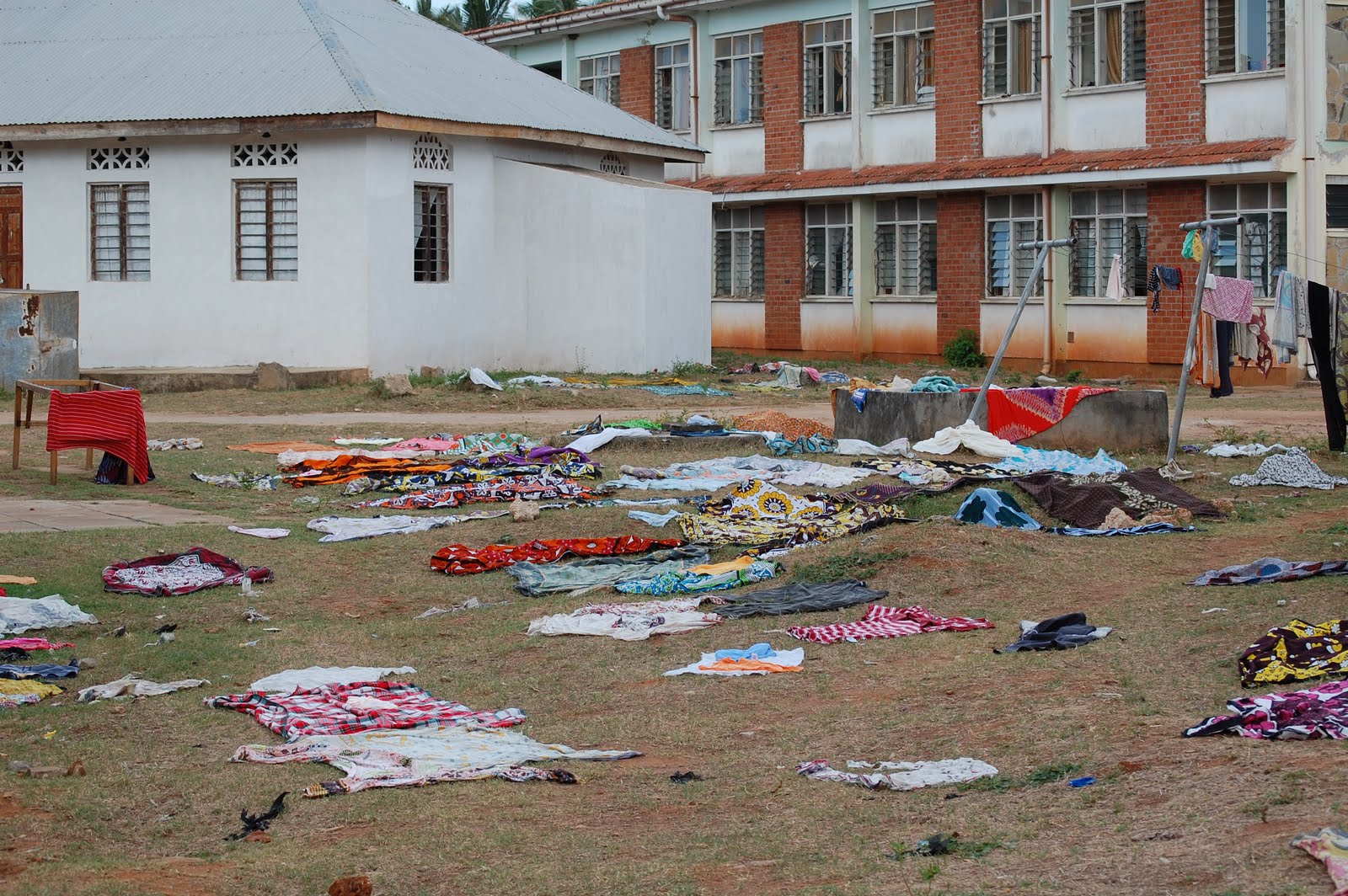
You often see the patient in bed but at least one female relative is sitting nearby to care for the patient. Patients who have no family nearby can really suffer under this arrangement but most people, thankfully, have someone who can help them. Just like in the U.S., it seems that the quality of care you receive often hinges on an attentive family member.
Wednesday, March 23, 2011
The brightest room in Kenya
You may have gathered from our other blogs that the coast is very different from the rest of Kenya. The coast still has significant Swahili and Muslim influences whereas the rest of the country is heavily influenced by Europe and the US.
In most of the country, Kenyans wear clothes indistinguishable from those worn in the U.S. Some years ago, second-hand clothing was introduced in Kenya and it has since become a massive industry. Supporters say that the second-hand clothes provides low-cost clothing to people who otherwise couldn’t afford clothing while detractors argue that it hurts the local textile industries and reduces them to creating novelty fabrics for tourists. Additionally, we’ve heard multiple rumors that much of this clothing as been donated in clothing drives in the U.S. and Europe only to be sold to Africans so that middle-men become rich. The introduction of “western-style” clothes means that most people in Kenya wear jeans, t-shirts, business suits, sneakers, and high heels instead of traditional clothing except on rare occasions.
The coastal people deviate from the U.S. influenced dress. Men wear the bright color kikoi as skirts and women usually wrap themselves in 2-3 different kangas. The women here adhere to traditional modesty so they are completely covered except for their faces and hands. While such attire seems oppressive when they wear the black bui buis, most coastal women favor head to toe kangas in many beautiful colors. This gives them a lot more choice of colors and patterns and somehow seems much more expressive than the U.S.-inspired dress or traditional Muslim clothing.
The kangas are truly beautiful on their own but when many women are together, it’s an unbelievable riot of color. Since M’s study focuses on children ages 0-3, each morning the waiting area next to the lab is filled with mother’s and young children wearing these gorgeous kangas. As part of documenting the study, I was permitted to take a few photos and I snapped some of my favorite photos in Kenya. I think the pictures speak for themselves.
Heshora weighing a pregnant mama: (notice her belly covered in kanga)

The outer waiting area:

The inner waiting area:


That is one seriously cute bum:

In most of the country, Kenyans wear clothes indistinguishable from those worn in the U.S. Some years ago, second-hand clothing was introduced in Kenya and it has since become a massive industry. Supporters say that the second-hand clothes provides low-cost clothing to people who otherwise couldn’t afford clothing while detractors argue that it hurts the local textile industries and reduces them to creating novelty fabrics for tourists. Additionally, we’ve heard multiple rumors that much of this clothing as been donated in clothing drives in the U.S. and Europe only to be sold to Africans so that middle-men become rich. The introduction of “western-style” clothes means that most people in Kenya wear jeans, t-shirts, business suits, sneakers, and high heels instead of traditional clothing except on rare occasions.
The coastal people deviate from the U.S. influenced dress. Men wear the bright color kikoi as skirts and women usually wrap themselves in 2-3 different kangas. The women here adhere to traditional modesty so they are completely covered except for their faces and hands. While such attire seems oppressive when they wear the black bui buis, most coastal women favor head to toe kangas in many beautiful colors. This gives them a lot more choice of colors and patterns and somehow seems much more expressive than the U.S.-inspired dress or traditional Muslim clothing.
The kangas are truly beautiful on their own but when many women are together, it’s an unbelievable riot of color. Since M’s study focuses on children ages 0-3, each morning the waiting area next to the lab is filled with mother’s and young children wearing these gorgeous kangas. As part of documenting the study, I was permitted to take a few photos and I snapped some of my favorite photos in Kenya. I think the pictures speak for themselves.
Heshora weighing a pregnant mama: (notice her belly covered in kanga)

The outer waiting area:

The inner waiting area:


That is one seriously cute bum:

Wednesday, March 9, 2011
Freezer Diving
So here’s what I did last week while M was at the conference:

That’s a -86 degree freezer that I have my head in. I actually got my entire upper body in it at one point. I also managed to freeze off my fingerprints because I was too eager to grab all the boxes I needed and didn’t wear the required ski gloves. I could have waited for one of the Kenyans to come back and help me but patience is not a virtue I possess.
So, what was I freezer diving for you might be thinking? Samples for M’s research. So, in laymen’s terms, the goal of M’s project is to link maternal infection (or lack thereof) while pregnant with the immune response of the babies after they are born. The working hypothesis is that women who were infected with malaria, schistosomiasis, hookworm, etc. while pregnant will have babies who are less able to mount a proper immune response to illness. It seems obvious but no one has proved this point yet; doing so would mean that women in the developing world will actually get treated while pregnant because there’s a cost-benefit in terms of the child’s health and (mostly foreign) aid agencies will pay for it.
So, the project involves testing samples of the babies blood for response childhood vaccinations (hepatitis, H. flu, tetanus, diphtheria) at 6 month intervals from birth to 36 months. All of the babies were born between 2006 and 2008 and they have been collecting blood samples from these babies ever since.
Since the project agreement requires that samples be taken in duplicate, there should be one test tube from each visit in Cleveland and one in Kenya. We were told that the ~3,000 samples M needed were in Kenya; this was not the case. No one is quite sure what happened but somehow all the samples were shipped to Cleveland about 2 weeks before we arrived. Like ships passing in the night, we just missed them.
So, I’m sure you’re thinking this isn’t a big deal, just send them back!!! No can do. There are several people in the lab running different tests on the samples and they were not happy with the idea that they would disappear back to Kenya for a year. So, a plan was developed to take a small amount from each sample and send them back to us. These samples could arrive in waves as people came from the lab every few months. As you can imagine, it’s rather annoying to pipette a small amount from 3,000 tubes into other tubes but it was really the only option. Also, the term for pipetting a small amount is “aliquoting”. Fun fact.
M and his samples:

Unfortunately as the months have gone by, only about 1,200 samples have arrived. Academic research is actually a pretty competitive environment and since very few other people in M’s lab would receive any direct benefit from getting him the samples, they haven’t arrived at quite the pace we had hoped. M has used his time very well, setting up the UTI project, shadowing in the hospital, and doing whatever lab tests he could while he waited but it was looking a bit dire last week.
As we previously mentioned, this week the primary investigators on M’s study were in Kenya and we all sat down to discuss these issues. Our main concern was that M have some publishable research completed by the time we leave so that he can apply to residency programs. After several long meetings, a plan has been devised that involves us running a lot more tests on the samples we have here and hopefully M will get some publishable data from that. We’ve calculated that it’s about 12ish weeks of work for both of us full-time in the lab but obviously I’m happy to help.
His and hers pipetting:

So, why was I freezer diving? Well M’s advisor pointed out that there were 600 follow-ups done last September that hadn’t been sent to Cleveland yet and that if we wanted to go through them to pull out the relevant 50 of them, we could do that. It was all the incentive I needed while he was away! Fifty more is a big increase when you only have 1,200 and I actually netted about 65 so it was a big win.

That’s a -86 degree freezer that I have my head in. I actually got my entire upper body in it at one point. I also managed to freeze off my fingerprints because I was too eager to grab all the boxes I needed and didn’t wear the required ski gloves. I could have waited for one of the Kenyans to come back and help me but patience is not a virtue I possess.
So, what was I freezer diving for you might be thinking? Samples for M’s research. So, in laymen’s terms, the goal of M’s project is to link maternal infection (or lack thereof) while pregnant with the immune response of the babies after they are born. The working hypothesis is that women who were infected with malaria, schistosomiasis, hookworm, etc. while pregnant will have babies who are less able to mount a proper immune response to illness. It seems obvious but no one has proved this point yet; doing so would mean that women in the developing world will actually get treated while pregnant because there’s a cost-benefit in terms of the child’s health and (mostly foreign) aid agencies will pay for it.
So, the project involves testing samples of the babies blood for response childhood vaccinations (hepatitis, H. flu, tetanus, diphtheria) at 6 month intervals from birth to 36 months. All of the babies were born between 2006 and 2008 and they have been collecting blood samples from these babies ever since.
Since the project agreement requires that samples be taken in duplicate, there should be one test tube from each visit in Cleveland and one in Kenya. We were told that the ~3,000 samples M needed were in Kenya; this was not the case. No one is quite sure what happened but somehow all the samples were shipped to Cleveland about 2 weeks before we arrived. Like ships passing in the night, we just missed them.
So, I’m sure you’re thinking this isn’t a big deal, just send them back!!! No can do. There are several people in the lab running different tests on the samples and they were not happy with the idea that they would disappear back to Kenya for a year. So, a plan was developed to take a small amount from each sample and send them back to us. These samples could arrive in waves as people came from the lab every few months. As you can imagine, it’s rather annoying to pipette a small amount from 3,000 tubes into other tubes but it was really the only option. Also, the term for pipetting a small amount is “aliquoting”. Fun fact.
M and his samples:

Unfortunately as the months have gone by, only about 1,200 samples have arrived. Academic research is actually a pretty competitive environment and since very few other people in M’s lab would receive any direct benefit from getting him the samples, they haven’t arrived at quite the pace we had hoped. M has used his time very well, setting up the UTI project, shadowing in the hospital, and doing whatever lab tests he could while he waited but it was looking a bit dire last week.
As we previously mentioned, this week the primary investigators on M’s study were in Kenya and we all sat down to discuss these issues. Our main concern was that M have some publishable research completed by the time we leave so that he can apply to residency programs. After several long meetings, a plan has been devised that involves us running a lot more tests on the samples we have here and hopefully M will get some publishable data from that. We’ve calculated that it’s about 12ish weeks of work for both of us full-time in the lab but obviously I’m happy to help.
His and hers pipetting:

So, why was I freezer diving? Well M’s advisor pointed out that there were 600 follow-ups done last September that hadn’t been sent to Cleveland yet and that if we wanted to go through them to pull out the relevant 50 of them, we could do that. It was all the incentive I needed while he was away! Fifty more is a big increase when you only have 1,200 and I actually netted about 65 so it was a big win.
Monday, March 7, 2011
Urology Conference
The surgery workshop was organized in conjunction with the Kenyan Urology Society annual scientific conference, which capped the week’s activities. I had submitted a research abstract to Dr. Kanyi about a month ago, and he invited me to present it at the meeting! We arrived at the Panafric Hotel, one of the nicest hotels in Nairobi, at about 9:15 for the advertised 9:30 start. I know, not smart with Kenyan time, right? We figured that this would start on time. The conference hall where we were supposed to be holding our meeting was full of pulmonologists discussing asthma. Apparently the hotel had forgotten about our meeting, despite a large exhibit hall filled with pharma reps hawking medicines for BPH (benign prostatic hyperplasia). Oh well. We just relaxed on a large outdoor porch and enjoyed some chai, cookies, and the morning sun.

I spotted the business center, and quickly popped by flashdrive into the computer, as I wanted to a few words on my PowerPoint presentation. All of the files on my flashdrive looked a little weird, and I couldn’t open my presentation! Fortunately, I sent myself the presentation on email, so I just re-downloaded it and saved it on my flashdrive. That worked fine, but I later found out that the business center computer basically erased my flashdrive! All 6 gigabytes! Fortunately I had backed it up a few weeks ago so I didn’t lose too much, but it’s pretty annoying that the business center doesn’t have better virus control. Maybe global health should expand to include computer health care (terrible joke).
At about 11:00 am, we were finally invited to go into the conference hall to get started. Kenya has about 25 urologists, nearly all of whom were in attendance, along with some general surgeons, residents, and nurses. I was the only med student at the conference, we think because the fee for the conference was pretty high (2,000 KSH, or $25). The conference consisted primarily of 15 minute presentations on various research projects that people have been working on. I presented on the rate of urinary tract infection among pregnant women at the hospital where I’m working. It’s just preliminary data right now, but was happy to be able to present and get some ideas from urologists for the follow-up study that we’re about to start.
Amazingly, we made up time and actually finished up at the prescribed time! We then headed over to the Nairobi Club for dinner. This is an old social club built by the Brits over 100 years ago. Lawn bowling? Cricket? A spot of tea? All could be had here. We had the main dining hall for our function. As we were enjoying a beer before dinner, word trickled through that Raila Odinga, the Prime Minister of Kenya, was apparently in the house. I never saw him, but I’ll believe the rumor.

Dinner was good, and afterwards I went back the guesthouse to get some sleep before my early flight back to Mombasa on Saturday morning. All in all, the week was even better than I had expected. Aside from the ambiguity of what we were actually going to do upon arrival, it really couldn’t have gone better. I met a ton of urologists who invited me to visit them at their various hospitals around the country. After seeing the generalist model of care in Msambweni, it was interesting to be part of the more specialized delivery at the tertiary care hospitals in Kenya. Hopefully I’ll have more to report soon!
Currently we have a full house here. Four colleagues are here from the US, so we’re really busy trying to plan for our next (and last) few months here.

I spotted the business center, and quickly popped by flashdrive into the computer, as I wanted to a few words on my PowerPoint presentation. All of the files on my flashdrive looked a little weird, and I couldn’t open my presentation! Fortunately, I sent myself the presentation on email, so I just re-downloaded it and saved it on my flashdrive. That worked fine, but I later found out that the business center computer basically erased my flashdrive! All 6 gigabytes! Fortunately I had backed it up a few weeks ago so I didn’t lose too much, but it’s pretty annoying that the business center doesn’t have better virus control. Maybe global health should expand to include computer health care (terrible joke).
At about 11:00 am, we were finally invited to go into the conference hall to get started. Kenya has about 25 urologists, nearly all of whom were in attendance, along with some general surgeons, residents, and nurses. I was the only med student at the conference, we think because the fee for the conference was pretty high (2,000 KSH, or $25). The conference consisted primarily of 15 minute presentations on various research projects that people have been working on. I presented on the rate of urinary tract infection among pregnant women at the hospital where I’m working. It’s just preliminary data right now, but was happy to be able to present and get some ideas from urologists for the follow-up study that we’re about to start.
Amazingly, we made up time and actually finished up at the prescribed time! We then headed over to the Nairobi Club for dinner. This is an old social club built by the Brits over 100 years ago. Lawn bowling? Cricket? A spot of tea? All could be had here. We had the main dining hall for our function. As we were enjoying a beer before dinner, word trickled through that Raila Odinga, the Prime Minister of Kenya, was apparently in the house. I never saw him, but I’ll believe the rumor.

Dinner was good, and afterwards I went back the guesthouse to get some sleep before my early flight back to Mombasa on Saturday morning. All in all, the week was even better than I had expected. Aside from the ambiguity of what we were actually going to do upon arrival, it really couldn’t have gone better. I met a ton of urologists who invited me to visit them at their various hospitals around the country. After seeing the generalist model of care in Msambweni, it was interesting to be part of the more specialized delivery at the tertiary care hospitals in Kenya. Hopefully I’ll have more to report soon!
Currently we have a full house here. Four colleagues are here from the US, so we’re really busy trying to plan for our next (and last) few months here.
Thursday, March 3, 2011
Kidney Transplant
On the final day of the surgery workshop, I was invited to help some of the adult urologists with a kidney transplant! KNH is one of only three or so centers in Africa with transplant capabilities. Their first transplant in Kenya was performed in 1978; the recipient was a young gentlemen whose kidney was removed because it was identified as an abdominal mass on an imaging study (he had “horseshoe kidney”, which results when the embryonic kidney fails to split in development). After that first surgery, the poor guy obviously had “renal failure”, but fortunately his loving sister was willing to spare a kidney for him, and they both walked out of the hospital two weeks later (with fantastic spread collar suits and afros, as this was 1978).
I scrubbed for the donor nephrectomy (where they take out the good kidney that is to be transplanted). It didn't do much but retract, but it was really cool to see the process. The kidney is very deep in the back/side, so it takes quite a bit of effort to get good visuals on the slippery guy. While we were harvesting the kidney, a vascular surgeon was preparing the site on the recipient where the kidney was to be attached (it's in the pelvis).
The surgeons freed all around the kidney, ligated any extraneous arteries and veins (such as those going to the adrenal glands which sit on top of the kidneys like little hats), and finally, clamped and cut the renal artery and vein, which supply the bulk of blood to the kidney. The main determinant of graft survival is “ischemia time”, or the amount of time that the kidney isn’t attached to the blood supply. It was definitely short in this case! We got the kidney out, someone ran it over, and by the time we were done closing the incision on the donor, the kidney was in the recipient and already making urine! Pretty amazing.
Rather than an intraoperative picture, which may offend some stomachs, here's a picture of a cute kid:

And part of the team at the end of the day:

I scrubbed for the donor nephrectomy (where they take out the good kidney that is to be transplanted). It didn't do much but retract, but it was really cool to see the process. The kidney is very deep in the back/side, so it takes quite a bit of effort to get good visuals on the slippery guy. While we were harvesting the kidney, a vascular surgeon was preparing the site on the recipient where the kidney was to be attached (it's in the pelvis).
The surgeons freed all around the kidney, ligated any extraneous arteries and veins (such as those going to the adrenal glands which sit on top of the kidneys like little hats), and finally, clamped and cut the renal artery and vein, which supply the bulk of blood to the kidney. The main determinant of graft survival is “ischemia time”, or the amount of time that the kidney isn’t attached to the blood supply. It was definitely short in this case! We got the kidney out, someone ran it over, and by the time we were done closing the incision on the donor, the kidney was in the recipient and already making urine! Pretty amazing.
Rather than an intraoperative picture, which may offend some stomachs, here's a picture of a cute kid:

And part of the team at the end of the day:

Sunday, February 27, 2011
Nairobi News: Meet and Greet
I arrived in Nairobi on Sunday at around noon for the urology workshop and conference that I mentioned in my previous post. My lovely wife was holding down the fort on the coast, as it was already a financial stretch to have me stay in Nairobi for a week, and she's actually been doing some pretty important work in the lab lately (thanks, E!).
The first order of business? Go to the secondhand market (Toi Market) and get some "nice" clothes for the week. Kenyans are quite formal; men nearly always wear slacks with a button-down tucked in. It's usually ill-fitting or well-worn due to it's secondhand-edness, but the spirit remains. I wasn’t expecting to attend any medical conferences while here, so I didn’t bring anything too nice. Anyways, I tried on about 50 pairs of pants at Toi Market, and finally found two winners. Not bad for $10.
In the evening, I had arranged to meet with the urologist from Stanford at his hotel, so we met and drank a beer. Soon the urologist from Switzerland joined us, and I then learned that there was actually a welcome reception at the hotel for us that evening. I had fortunately opted for the khakis and oxford over the jeans and rugby that I strongly considered.
The welcome reception was a small gathering of about 10 urologists from around Kenya (mostly Nairobi), and we just had some "bitings" and drinks. I had met or talked to a few of them before, but others were a little confused as to who I was, as only two pediatric urologists were to attend this workshop. I explained that we lived here, and that I was technically a member of the same urology organization, but they didn't specifically send me here, but I was excited to learn. This explanation of me showing up at their conference seemed to suit everyone just fine, and conversation shifted to things which interested them more, specifically my height. We retired after a few Tuskers to rest up for the next day.
I must say, I was a little apprehensive about the workshop and conference week, as I had literally no details, but Day 1 went smoothly and I was really looking forward to the coming week.
The first order of business? Go to the secondhand market (Toi Market) and get some "nice" clothes for the week. Kenyans are quite formal; men nearly always wear slacks with a button-down tucked in. It's usually ill-fitting or well-worn due to it's secondhand-edness, but the spirit remains. I wasn’t expecting to attend any medical conferences while here, so I didn’t bring anything too nice. Anyways, I tried on about 50 pairs of pants at Toi Market, and finally found two winners. Not bad for $10.
In the evening, I had arranged to meet with the urologist from Stanford at his hotel, so we met and drank a beer. Soon the urologist from Switzerland joined us, and I then learned that there was actually a welcome reception at the hotel for us that evening. I had fortunately opted for the khakis and oxford over the jeans and rugby that I strongly considered.
The welcome reception was a small gathering of about 10 urologists from around Kenya (mostly Nairobi), and we just had some "bitings" and drinks. I had met or talked to a few of them before, but others were a little confused as to who I was, as only two pediatric urologists were to attend this workshop. I explained that we lived here, and that I was technically a member of the same urology organization, but they didn't specifically send me here, but I was excited to learn. This explanation of me showing up at their conference seemed to suit everyone just fine, and conversation shifted to things which interested them more, specifically my height. We retired after a few Tuskers to rest up for the next day.
I must say, I was a little apprehensive about the workshop and conference week, as I had literally no details, but Day 1 went smoothly and I was really looking forward to the coming week.
Wednesday, February 23, 2011
Pippetting in Kenya
As M previously mentioned, I am helping out in the lab for a few weeks so we don’t overwork the Kenyans. Working alongside Mzungu has been interesting to say the least. First, notice his name? Yes, his given name is the exact same word as “person of European descent” that people constantly yell at us. Why you would name your Kenyan child, “person of European descent”, I have no idea but it sort of rounds out his oddities so I guess it makes sense.
Despite having an excellent command of English (including lab terms), Mzungu rarely does more than grunt when you speak to him. In fact, he’s perfected the non-response to the point where you’re often not sure whether he has heard the question. The hilarious thing is that despite uttering about 25 words a day directed at me in the 8 hours we spend together, he actually speaks to me significantly more than the other people in the lab. The other men in the lab enter every morning and greet only M, asking him about his health, his sleep, and making pleasant morning conversation. I think I’m adapting to Kenya because M noticed that they don’t speak to me, I didn’t even register this fact.
Mzungu is a trained laboratory technician but he does not, under any circumstances, multi-task. He was thoroughly horrified that I was labeling the next set of tubes the first day while the samples were spinning in the centrifuge.
He spent 2 full days this past week watching my every move with the pipette. After the 15th hour over 2 days, I asked him if I was doing it ok or if he had any suggestions. He shook his head. I asked if he wanted to take over and he again shook his head.
The end of the experiments involves plating all the samples and then applying different antigens to see whether or not the baby is making the correct antibodies to infectious agents. You can plate 2 samples on each plate so I usually make 3-5 plates per day. 90% of what goes on each plate is the same since the process is standardized. The only thing deviating from plate to plate is the sample of the baby’s blood. Given this 90% continuity across plates, I typically plate the samples one by one but then add the first antigen to all the plates before moving on to the second antigen, etc. This allows me to be efficient and not to have to open and close plates and antigens constantly. Mzungu watched this whole process silently before just shaking his head.
To be fair, I’m sure he’s concerned that I’m being accurate given the importance of processing these samples. I know, however, that this organization is actually preventing me from making mistakes since this is how my brain is organized. Also, it’s kind of ironic to be concerned about quality control when you were so concerned that you had help in the lab that you allowed me, an untrained biotech consultant, to take on 50% of your job. In the past, they’ve had 2 Kenyans [Mzungu + 1 other] do this job that I estimate takes me roughly 4 solid hours plus Mzungu’s 3-4 hours. For those of you playing at home, that’s eight hours of actual work but it’s important that the lab people don’t feel overworked and walk off the job during the all important follow-up appointments for the babies or the lab loses all its data.
The upside is that I also am able to help M with his experiments every morning. Plus, we get to blare country music and watch Mzungu make faces about how terrible it is, and that is totally worth it.
Despite having an excellent command of English (including lab terms), Mzungu rarely does more than grunt when you speak to him. In fact, he’s perfected the non-response to the point where you’re often not sure whether he has heard the question. The hilarious thing is that despite uttering about 25 words a day directed at me in the 8 hours we spend together, he actually speaks to me significantly more than the other people in the lab. The other men in the lab enter every morning and greet only M, asking him about his health, his sleep, and making pleasant morning conversation. I think I’m adapting to Kenya because M noticed that they don’t speak to me, I didn’t even register this fact.
Mzungu is a trained laboratory technician but he does not, under any circumstances, multi-task. He was thoroughly horrified that I was labeling the next set of tubes the first day while the samples were spinning in the centrifuge.
“How do you know how to label the tubes” he exclaimed
“Well I was copying them from your log book and then I double-check them when the samples are done spinning”
[Furrowed brow, no further comment]
He spent 2 full days this past week watching my every move with the pipette. After the 15th hour over 2 days, I asked him if I was doing it ok or if he had any suggestions. He shook his head. I asked if he wanted to take over and he again shook his head.
“Well, I think you can probably do it faster than me and I feel badly that I’m not saving you any time since you have to watch me so let me know if you want to do it”
[Quick scurrying away, no further oversight from him, luckily M's lab advisor is here and I'm doing it fine]
The end of the experiments involves plating all the samples and then applying different antigens to see whether or not the baby is making the correct antibodies to infectious agents. You can plate 2 samples on each plate so I usually make 3-5 plates per day. 90% of what goes on each plate is the same since the process is standardized. The only thing deviating from plate to plate is the sample of the baby’s blood. Given this 90% continuity across plates, I typically plate the samples one by one but then add the first antigen to all the plates before moving on to the second antigen, etc. This allows me to be efficient and not to have to open and close plates and antigens constantly. Mzungu watched this whole process silently before just shaking his head.
To be fair, I’m sure he’s concerned that I’m being accurate given the importance of processing these samples. I know, however, that this organization is actually preventing me from making mistakes since this is how my brain is organized. Also, it’s kind of ironic to be concerned about quality control when you were so concerned that you had help in the lab that you allowed me, an untrained biotech consultant, to take on 50% of your job. In the past, they’ve had 2 Kenyans [Mzungu + 1 other] do this job that I estimate takes me roughly 4 solid hours plus Mzungu’s 3-4 hours. For those of you playing at home, that’s eight hours of actual work but it’s important that the lab people don’t feel overworked and walk off the job during the all important follow-up appointments for the babies or the lab loses all its data.
The upside is that I also am able to help M with his experiments every morning. Plus, we get to blare country music and watch Mzungu make faces about how terrible it is, and that is totally worth it.
Monday, February 21, 2011
Lab / Hospital / Barnyard Update

Just a quick note as to what’s going on down at the hospital:
E has been going down to the lab to help with a project that we’re a little shorthanded on right now. Well, technically we’re not shorthanded, but it would require a lab tech to put in a full day of work, which is obviously unacceptable. What about chai at 10 am?! 12-2 lunch hour(s)?! These things are sacred, so we’ve brought in the Little One.
The process involves taking blood samples from the kids, and processing them into separate tubes of red blood cells, white blood cells, and plasma. It can be a bit arduous, but with the help of a centrifuge, it only takes a few hours. Anyways, it took about one day of observing, one day of doing while being observed, and now she’s of course found the most efficient way of doing it and finishes more quickly than the tech. It’s awesome of her to help out; it’s nice to have a little company down at the lab, she’s helping the project, and it’s allowing me to go to Nairobi this week for a urology conference (more on that later).
My projects are a little slow right now, but moving forward. The study where I’ll do urine cultures to look for UTIs has been fully approved, but we were waiting on one reagent from the US. Several people just came over and they brought a few boxes of supplies. The reagent was packed, but when the box was opened at the lab, it was not there. We did find a TSA slip saying that they inspected the box, and I wonder if they didn’t put this item back. It’s just too bad because it is literally worthless to 99.99% of the world, but cost $275 and we need it to get started.
I am in Nairobi for the week to attend a urology workshop and conference put on by the Kenyan Association for Urologic Society. The workshop is put on by two pediatric urologists from the US and Switzerland, and will focus on pediatric reconstructive surgery. There are no pediatric urologists in the country, so they’ll be training pediatric surgeons to do certain cases. I’m excited to spend some time in a larger hospital in Kenya (this is the largest teaching hospital in the country). Like most things here, there is still no itinerary, but I just know that I need to be at the hospital at 8:30 AM this morning.
On Friday, E and I made the observation that people are quite a bit closer to nature here than in the US. E shrieked while she was pipetting samples because there was a huge spider inside of the “sterile” hood. While I was away on a 1.5 hour sit-in waiting for the head of the hospital to meet with me (long story), E also dealt with a shrimper who had come by the lab to sell his catch (his price was too high).
As we were about to leave for the day, E ran to another room to grab something, and my favorite goat, one that makes a bleating sound like the girl in The Exorcist, ambled by. Unfortunately, she missed it again. We walked to the truck, and standing directly next to it were a pair of small cows. E approached one as you would a dog, and it proved pet-able. E’s new friend:


E managed to go from separating blood components under a sterile hood to petting a cow in about 30 seconds. This is a strange place. We will update more from the conference and from the lab this week.
Monday, January 10, 2011
Medical Dealings
Real life restarted on January 4th. E is very glad to be back with "her kids" and I have returned to my research and clinical work.
I spent a recent morning in clinic with one of the medical officers (read: generalist physician). The usual suspects showed up: lots of hernias, hydroceles, keloids, etc. After the hospital’s surgeon left in the fall, the surgical caseload at this hospital has dropped dramatically, as only the cases that are simple and have a very low likelihood of complication are attempted, as the doctors and nurses have no backup if something goes wrong.
So, we were referring most of the cases to Coast General Hospital in Mombasa, which is the tertiary care government hospital for Coast Province (one of seven districts in Kenya). Coast General has many “consultants”; specialists such as cardiologists, pediatricians, surgeons, and the like. One patient was brought in by his son, who happened to be a clinical officer (read: nurse) at the hospital. The man needed a hernia repair, and the son said that he knew that they weren’t doing that surgery at this hospital anymore. They discussed how much money they had for the surgery, and after some math that I didn’t understand, the man was booked for surgery the next day at our hospital! After the patient left, I asked the doctor what the 6,000 KSH was in her math.
Apparently saying that someone has to go to Coast General is essentially ensuring a six month to one year wait for an elective surgery. The patient’s son fully understood this, and seemed delighted that the doctor would accept some under-the-table money to do his father’s surgery. From the doctor’s side, she otherwise has no incentive to take patients to the OR, as government doctors are paid a salary, and if she messes up in the OR, she can be charged with malpractice for performing surgery without a surgeon around. Corruption is so pervasive in this country that this isn’t surprising, and I honestly wasn’t even very upset by this graft. This extra fee seemed to me like a roundabout malpractice insurance. Though definitely not condoning it, but it goes to show how quickly one can become accustomed to a corrupt system.
I spent a recent morning in clinic with one of the medical officers (read: generalist physician). The usual suspects showed up: lots of hernias, hydroceles, keloids, etc. After the hospital’s surgeon left in the fall, the surgical caseload at this hospital has dropped dramatically, as only the cases that are simple and have a very low likelihood of complication are attempted, as the doctors and nurses have no backup if something goes wrong.
So, we were referring most of the cases to Coast General Hospital in Mombasa, which is the tertiary care government hospital for Coast Province (one of seven districts in Kenya). Coast General has many “consultants”; specialists such as cardiologists, pediatricians, surgeons, and the like. One patient was brought in by his son, who happened to be a clinical officer (read: nurse) at the hospital. The man needed a hernia repair, and the son said that he knew that they weren’t doing that surgery at this hospital anymore. They discussed how much money they had for the surgery, and after some math that I didn’t understand, the man was booked for surgery the next day at our hospital! After the patient left, I asked the doctor what the 6,000 KSH was in her math.
“That’s for us!”, she replied.
“I thought that the 2,500 for ‘theatre fees’ was the extent of the charges?”
“Oh, it is, but this is just a small corruption because I’m doing them a favor and I give some to the anesthetist, and some buys the normal saline.”
Apparently saying that someone has to go to Coast General is essentially ensuring a six month to one year wait for an elective surgery. The patient’s son fully understood this, and seemed delighted that the doctor would accept some under-the-table money to do his father’s surgery. From the doctor’s side, she otherwise has no incentive to take patients to the OR, as government doctors are paid a salary, and if she messes up in the OR, she can be charged with malpractice for performing surgery without a surgeon around. Corruption is so pervasive in this country that this isn’t surprising, and I honestly wasn’t even very upset by this graft. This extra fee seemed to me like a roundabout malpractice insurance. Though definitely not condoning it, but it goes to show how quickly one can become accustomed to a corrupt system.
Saturday, December 18, 2010
Trashed
E and I were walking through the hospital on the way back from lunch yesterday and we came across an interesting pile: syringes, ampules of medicines (Valium, adrenaline, anti-malarials, to name a few), and various other medical sundries. These were unceremoniously piled on the floor of the waiting room for the pediatric clinic. From the appearance, I think that these were long-expired medical supplies awaiting a yet unknown fate. I do hope that fate isn’t in a crawling child’s belly.

I’ve run into the issue of getting things disposed of properly here. A few weeks after I arrived, office space was scarce, partially because a good deal of real estate was taken up by archaic computers and printers that haven’t been used for 20+ years. I inquired about getting rid of the junk, and I was told that nothing could be done without a signed letter from the boss giving permission. Fine, so with eager naivety, I spent the next several hours pulling the very dusty, very old equipment from desks and shelves to catalog. I then typed up a letter, sent it to my the head of the study at my school, and by mid-afternoon, the letter was here. Alright!
Me: “Where are we taking all of the stuff?”
Lab people: “Let’s put it back on the shelves for now”
Me: “Why? Let’s just get rid of it. We can’t sell this stuff”
Lab people: “Let’s just leave it for now”
Fast-forward four months. Everything remains where it was. The very large computer box pictured below is in the middle of my lab floor, obstructing my path every day. I tried to deal with it the other day, and was told that “we should leave it there for the time being”. I’m beginning to think that Kenyans might be the human equivalent of Ents, the giant, slow-moving tree-people from Lord of the Rings. Literally, it is impossible to get anything done with any sort of alacrity. Geologic time is more the clock that we’re on here. It’s not that their pace of life is wrong, but that it’s just so incongruent with the haste that Americans are used to, it’s hard to deal with sometimes.
I'm pretty sure this was the latest model circa 1990:

To be fair, part of the problem has to do with lack of infrastructure in dealing with waste. There aren’t many trashcans around, so people just end up throwing their trash along the side of the road. This may have been acceptable when the vast majority of the waste was organic, but now, plastic bottles litter the country. In E’s Ukunda post, she showed the town’s trash infrastructure. Not so sweet. I’m not even sure if disposal of large items (i.e. refrigerators, cars, etc) is ever dealt with. Check out the Land of Forgotten Hospital Toys. It is a 15x15 room piled to the ceiling with I don’t know what and it will remain there for another 30 or so years. I imagine someday that someone will excavate this hospital and think that the Kenyans worshiped old and broken machines since they kept them all.

While the old machines are a nuisance, the expired medicines could actually be pretty dangerous. Kenyans are very resourceful and I can easily see someone trying to make a quick buck by selling these expired medicines. Since most of these things can be bought at a pharmacy without a prescription, buying medicines from someone at a kiosk is not foreign to Kenyans.
We're headed off to Israel in just a few hours to meet up with some of E's family for Christmas. Hopefully we'll be able to go to a Christmas service in Bethlehem, but as of right now, it seems there's no room at the inns (seriously, they're all booked up). We are REALLY excited to have a change of scenery and food for a while, as well as seeing some familiar faces!
On an unrelated note, I just received this text from our Swahili teacher, who has now missed six straight lessons, due to toothaches, malaria, or just plain forgetting:
"M and E, poleni sana! (very sorry!), beginning to remember now that I was to come for Swahili y'day evening. Some matters and issues have really consumed even the memory section of my brain. Twice having not fulfilled my promise due to forgetfulness?? The whole idea may sound hypocritical but in reality this is what has been like this week. Just bear with me for the near-fatal state of mind. Kindly accept my apology, I'm very sorry for the expectation and anticipation I created in you. Have a wonderful weekend! Juma"
We laughed for a long time at that one. Oh well, pole pole (slowly, slowly).
Anyway, Merry Christmas to you all, have a wonderful holiday!
Love,
M & E

I’ve run into the issue of getting things disposed of properly here. A few weeks after I arrived, office space was scarce, partially because a good deal of real estate was taken up by archaic computers and printers that haven’t been used for 20+ years. I inquired about getting rid of the junk, and I was told that nothing could be done without a signed letter from the boss giving permission. Fine, so with eager naivety, I spent the next several hours pulling the very dusty, very old equipment from desks and shelves to catalog. I then typed up a letter, sent it to my the head of the study at my school, and by mid-afternoon, the letter was here. Alright!
Me: “Where are we taking all of the stuff?”
Lab people: “Let’s put it back on the shelves for now”
Me: “Why? Let’s just get rid of it. We can’t sell this stuff”
Lab people: “Let’s just leave it for now”
Fast-forward four months. Everything remains where it was. The very large computer box pictured below is in the middle of my lab floor, obstructing my path every day. I tried to deal with it the other day, and was told that “we should leave it there for the time being”. I’m beginning to think that Kenyans might be the human equivalent of Ents, the giant, slow-moving tree-people from Lord of the Rings. Literally, it is impossible to get anything done with any sort of alacrity. Geologic time is more the clock that we’re on here. It’s not that their pace of life is wrong, but that it’s just so incongruent with the haste that Americans are used to, it’s hard to deal with sometimes.
I'm pretty sure this was the latest model circa 1990:

To be fair, part of the problem has to do with lack of infrastructure in dealing with waste. There aren’t many trashcans around, so people just end up throwing their trash along the side of the road. This may have been acceptable when the vast majority of the waste was organic, but now, plastic bottles litter the country. In E’s Ukunda post, she showed the town’s trash infrastructure. Not so sweet. I’m not even sure if disposal of large items (i.e. refrigerators, cars, etc) is ever dealt with. Check out the Land of Forgotten Hospital Toys. It is a 15x15 room piled to the ceiling with I don’t know what and it will remain there for another 30 or so years. I imagine someday that someone will excavate this hospital and think that the Kenyans worshiped old and broken machines since they kept them all.

While the old machines are a nuisance, the expired medicines could actually be pretty dangerous. Kenyans are very resourceful and I can easily see someone trying to make a quick buck by selling these expired medicines. Since most of these things can be bought at a pharmacy without a prescription, buying medicines from someone at a kiosk is not foreign to Kenyans.
We're headed off to Israel in just a few hours to meet up with some of E's family for Christmas. Hopefully we'll be able to go to a Christmas service in Bethlehem, but as of right now, it seems there's no room at the inns (seriously, they're all booked up). We are REALLY excited to have a change of scenery and food for a while, as well as seeing some familiar faces!
On an unrelated note, I just received this text from our Swahili teacher, who has now missed six straight lessons, due to toothaches, malaria, or just plain forgetting:
"M and E, poleni sana! (very sorry!), beginning to remember now that I was to come for Swahili y'day evening. Some matters and issues have really consumed even the memory section of my brain. Twice having not fulfilled my promise due to forgetfulness?? The whole idea may sound hypocritical but in reality this is what has been like this week. Just bear with me for the near-fatal state of mind. Kindly accept my apology, I'm very sorry for the expectation and anticipation I created in you. Have a wonderful weekend! Juma"
We laughed for a long time at that one. Oh well, pole pole (slowly, slowly).
Anyway, Merry Christmas to you all, have a wonderful holiday!
Love,
M & E
Monday, November 29, 2010
Excel for Kenyans

As previously mentioned, I have been helping M out in the lab every day since school ended. Due to some delays, he only just received many of the samples necessary for his work so he has quite the backlog and so I’ve been helping him work on lab experiments.
M’s work is just one of several projects ongoing simultaneously in the hospital’s labs. From what I can tell, they are quite active in research in the overlap between infectious disease and entomology since so many diseases here are mosquito/insect transmitted. The Center for Global Health and Disease at Case works quite closely with a number of Kenyan organizations in this research so M has gotten to know some of the researchers. Many of these researchers are PhD or Masters students in either public health or entomology and are doing thesis work. This involves a significant amount of data collection that they have to analyze for their theses. Word got around that I was assisting the primary investigator on M’s study with some of her backlogged data and I was asked to “show some students some basic Excel tricks”. No problem.
Fast forward a few days and I’m shown a flyer where I’m advertised as giving a full presentation for Continuing Medical Education (CME) at the hospital for doctors, hospital administrators, and the researching students. Now CME in the US is a requirement for medical professionals to keep up on their skills. Needless to say it’s taught by someone MEDICAL. I definitely don’t count. In fact by my estimation, I would actually the least educated person in the room based on degrees conferred. Perfect.
Now I spent the last 5 years working with Excel almost daily so I know how to analyze data. They wanted me to present, however, on data collection and data management. Not a whole lot of data collection in biotech consulting but ok, I can do this. So, I began by asking the students what they wanted to learn and kept getting the same response: “I want to learn to analyze my data in Excel”. Oh, that really narrows it down. Several promised to send me their data and copies of their previous analyses so I could see what they needed to accomplish. I’m sure you’ll be shocked to hear that no one sent me anything. In a lucky break, however, I did manage to sneak a look at one girl’s data while I used the bathroom in another lab so I had some idea of how she could reformat it more effectively for analysis.
I made up some dummy datasets and created a 23 slide presentation over the weekend. Although I’ve been in many more stressful business situations, I wanted to make sure I didn’t waste anyone’s time (doctor’s are at a premium in Kenya!) or reflect poorly on M or M’s lab (an actual concern given the status of wives in the part of coastal Kenya where the hospital is).
The presentation was slated from 12:30-2. We considered heading up there at noon to set up but realized that would be foolish. We headed up right at 12:30 and were met by an empty room. Eventually someone showed up with a projector and we continued to wait. People started straggling in around 1:00 and we started at 1:05. They all just kept saying “oh, we’re on Kenyan time” as they arrived late. No one had misplaced the time, this is actually a conscious choice to not show up on time though I suppose you have little incentive to come on time if no one else does. Didn’t really phase me since I expected it but it is interesting.
So, I proceeded to give my presentation as slowly as I could and tried to give a lot of examples. I was met with a lot of silence and stares. Definitely not my toughest audience but it was hard to gauge any reaction since no one had any questions. Later I approached several of the students and said I knew that the presentation had been pretty basic and I was happy to answer their more complex questions and they all said that they had actually learned a lot.
After talking with some of our missionary friends later, I think there are several possible reasons for the silence and the reality is probably some combination of all of these items. First, they didn’t want to embarrass me and asking a question could make it seem that I hadn’t taught the material well. Second, they don’t want to expose their own confusion/lack of knowledge in front of their colleagues. Third, I’m a young mzungu woman and the racial/cultural/religious/language barriers are huge in Msambweni which is a mostly Muslim, rural, fishing village.
Afterwards, I had to sign their CME manuals to verify their attendance. I tried to demure that it wasn’t really CME but they were insistent that they get credit for their attendance! So, I signed my name. Anyway, people seemed appreciative later and at the very least, hopefully it was a goodwill gesture for M’s lab.
We head to Nairobi via night bus tonight and then will travel to Kisumu for a half-marathon on Wednesday for World AIDS Day. Kisumu is in Western Kenya on the shores of Lake Victoria and the drive from Nairobi to Kisumu will include driving through the Rift Valley. After the half marathon, we plan to travel through some of the smaller national parks in the Rift Valley. We're going to try and post from the road but we are always mindful that you can never count on anything to go as planned so we shall see. Have a great start to the week!
View Mombasa to Kisumu in a larger map
Tuesday, October 26, 2010
The sukari (sugar)
I came to the hospital here expecting to see many medical conditions that I’d never see in the states. Indeed I have; malaria, leprosy, elephantiasis, to name a few. I spent some time in clinic with one of the doctors and guess what the visits were most frequently for? Diabetes and hypertension. I’m not certain of the exact rates, but these are no longer disease of the Western world. Many areas of the world that have become “Americanized”, and in some ways, especially with music and dress, Kenya is no exception. However, there are no McDonalds here (not even in Nairobi), and it is uncommon to see overweight Kenyans. Most people have enough food, but in some regions, such as Turkana in the northeast portion of the country, people are starving and eating their dogs.
The areas covered by this hospital are rural (as in, no electricity), and most people do physical work, so the population couldn’t be much more different from the American population. I’m sure the rates of diabetes are not the insane ~30% that we have in America, but seeing that these diseases were common at all here was surprising to me. I think that the reasons are twofold. 1) Though most of what people eat here is not terribly familiar, it is creeping toward the “processed foods” end of the spectrum. Sitting at break time and drinking chai and eating six slices of white bread slathered with margarine is a daily occurrence for many Kenyans. It’s cheap, tastes good, is filling, and devoid of nutrients; sounds a little more like McDonalds now. 2) People are living longer, and since they’re not dying at a very young age of smallpox or whatnot, something has to kill them.
Kenya remains a country where being overweight is considered a positive thing; it indicates that you’re prosperous enough to pack on some pounds. We had a few of E’s fellow teachers over the other day (young women), and they were saying how whenever they go home, their dads tell them that they should eat more and get fat, and how food is “wasted” on them if they don’t show signs of weight gain. E got a little slack-jawed at this point; this is not a directive typically heard in an American home, especially toward women. While gross obesity is not the goal, the typical Kenyan man definitely prefers somewhat larger women than most American men. This ideal used to make a lot of sense, as one could store some fuel for lean times, but now, as calories become cheaper, more processed, and less nutritious, the extra weight stops being an asset and starts being a liability. The Kenyan health system is ill-prepared to deal with complicated chronic disease management, which is a struggle even in the resource-rich US.
The areas covered by this hospital are rural (as in, no electricity), and most people do physical work, so the population couldn’t be much more different from the American population. I’m sure the rates of diabetes are not the insane ~30% that we have in America, but seeing that these diseases were common at all here was surprising to me. I think that the reasons are twofold. 1) Though most of what people eat here is not terribly familiar, it is creeping toward the “processed foods” end of the spectrum. Sitting at break time and drinking chai and eating six slices of white bread slathered with margarine is a daily occurrence for many Kenyans. It’s cheap, tastes good, is filling, and devoid of nutrients; sounds a little more like McDonalds now. 2) People are living longer, and since they’re not dying at a very young age of smallpox or whatnot, something has to kill them.
Kenya remains a country where being overweight is considered a positive thing; it indicates that you’re prosperous enough to pack on some pounds. We had a few of E’s fellow teachers over the other day (young women), and they were saying how whenever they go home, their dads tell them that they should eat more and get fat, and how food is “wasted” on them if they don’t show signs of weight gain. E got a little slack-jawed at this point; this is not a directive typically heard in an American home, especially toward women. While gross obesity is not the goal, the typical Kenyan man definitely prefers somewhat larger women than most American men. This ideal used to make a lot of sense, as one could store some fuel for lean times, but now, as calories become cheaper, more processed, and less nutritious, the extra weight stops being an asset and starts being a liability. The Kenyan health system is ill-prepared to deal with complicated chronic disease management, which is a struggle even in the resource-rich US.
Thursday, September 23, 2010
It's getting hot in here

Though air-conditioned, the operating theatre here is not the cool 60 degrees that they spoil us with in the States. For those who have never been scrubbed into a surgery, once you add the surgical cap, a mask over the nose and mouth, a full-length gown, rubber gloves, and surgical lamps aimed at you, things can get pretty hot. The OR has to be very cold to keep the surgeon from dripping sweat onto the patient, as this is less than sterile. In the US, gowns are made of an impermeable paper (not sure how they do it), so they’re actually quite light. Here, one wears the big galoshes, a heavy rubber apron, and then a cloth gown over that.
The other day I was invited to scrub in to get a closer look at the surgery. I excitedly washed up (with a bar of soap, not the single use sponge/brush/fingernail cleaner from the Ttates), and put on my gown and gloves. Then, I noticed that the room was a little too quiet. One of the nurses had turned off the air conditioning because it was “too cold” in the room. Kenyans hate air conditioning; multiple people have told us that they came down with pneumonia from being around it.
It started with my back; beads of sweat marching towards my waistband. Soon, there was a line of sweat beads visible to me, dancing on my eyebrows, just waiting for my signal to drop onto the surgical field. The surgeon across from me displayed no sign of discomfort. It looked as it he’d just powdered his face. Soon, I would be soaked; I knew this. I was simply standing there, definitely not exerting myself, but the sweat did not abate. By the time the surgery ended, I had only dripped a little bit, and not near the incision, so that was good. However, my scrubs were not in were not so lucky. I took off my butcher’s apron, which revealed the damage. Those of you who saw me or picture of me at the Fitzpatrick wedding in Phoenix a few years ago have some idea of my appearance at this time. Malesi (a nurse) looked me head to toe and with a slight smile said, “you should change now”. What he didn’t say, but was on his face, was “crazy mzungu…”.
I am very much enjoying the operating theatre, but my European hypothalamus and sweat glands are not doing a good job of adapting to the climate here. I have since been asked “why do you sweat so much?”, and heard comments such as “you’re really suffering”. I’ll survive, but this is also the “coldest” time of year. Perhaps I’ll go on surgery sabbatical in January…
Thursday, September 16, 2010
Theatre Musings
In the US, the operating theatre is known as a place where surgeons can “get away” from their patients. I know this sounds funny, but once the patient is anesthetized (put to sleep), and draped, to the surgeon, the “person” isn’t there anymore. What you have in front of you is a small window of skin, a canvas, if you will. This is why after the initial shock of seeing blood in the OR, that revulsion simply disappears for most people, as the blood doesn’t seem to be coming from a person who is in pain, but rather from a sterile field. I’m not saying that surgeons don’t still feel a great deal or responsibility for the person whom they saw in clinic, or with whom they discussed the risks and benefits of surgery, etc., but there is a certain remove once in the OR, as the patient is not conscious (there are exceptions, but this is the general rule).
In the OR where I’ve been working, very few cases are done under general anesthesia; most are spinal, so the patient is wide awake. This is something that I’m slowly growing accustomed to as I practice drawing blood and placing IVs on conscious patients; it’s strange to knowingly inflict pain on another person. However, the idea of being deep inside of someone’s abdomen while chatting with him just bizarre.
During some surgeries, especially ones with a lot of organ manipulation, the patient will actually moan in pain or give an “oww!” in Swahili! This usually encourages some sedative to take the edge off, but because the patient is lying on their back, there’s no opportunity to give more spinal anesthesia. There’s a real intimacy in knowing that a patient can hear everything that you say while you’re operating, and in being able to speak with and comfort patients at the same time.
This is something that we take for granted in the US. I’ve seen surgeons throw instruments across the room because the sedation was too light and the patient’s leg moved once or twice, though was still completely unconscious. Surgeons tend to let conversations wander; from “Hey Suzie, can you please call my wife and tell her that I talked to the plumber and he’s coming over this afternoon?”, to “I can’t believe that the Bachelorette chose Mark!” to things I cannot write in mixed company. I participate in this banter as well, and especially in urology, you can imagine that conversation tends towards juvenile jokes pretty quickly. While I’m not advocating surgery while patients are thrashing around, it might not be a bad thing to be occasionally reminded that you’re working on a person under those drapes.
In the OR where I’ve been working, very few cases are done under general anesthesia; most are spinal, so the patient is wide awake. This is something that I’m slowly growing accustomed to as I practice drawing blood and placing IVs on conscious patients; it’s strange to knowingly inflict pain on another person. However, the idea of being deep inside of someone’s abdomen while chatting with him just bizarre.
During some surgeries, especially ones with a lot of organ manipulation, the patient will actually moan in pain or give an “oww!” in Swahili! This usually encourages some sedative to take the edge off, but because the patient is lying on their back, there’s no opportunity to give more spinal anesthesia. There’s a real intimacy in knowing that a patient can hear everything that you say while you’re operating, and in being able to speak with and comfort patients at the same time.
This is something that we take for granted in the US. I’ve seen surgeons throw instruments across the room because the sedation was too light and the patient’s leg moved once or twice, though was still completely unconscious. Surgeons tend to let conversations wander; from “Hey Suzie, can you please call my wife and tell her that I talked to the plumber and he’s coming over this afternoon?”, to “I can’t believe that the Bachelorette chose Mark!” to things I cannot write in mixed company. I participate in this banter as well, and especially in urology, you can imagine that conversation tends towards juvenile jokes pretty quickly. While I’m not advocating surgery while patients are thrashing around, it might not be a bad thing to be occasionally reminded that you’re working on a person under those drapes.
Subscribe to:
Posts (Atom)